


Brands in gaming don’t have to be intrusive ads or awkward product drops. The best brand presence in video games is designed to fit the culture, respect gameplay, and add value - whether that value is entertainment, utility, rewards, or community experiences.
What’s changed is scale and diversity. Gaming isn’t a niche audience; it’s mainstream, multi-generational, and deeply social - so the same brand can show up in very different ways depending on genre, platform, and player motivations. According to ESA Essential Facts 2024, 61% of the U.S. population reports playing video games at least 1 hour per week.
What “brand presence in video games” actually includes
When marketers mean brands in video games, they usually mean one of three things:
- In-game advertising (placements, audio, overlays, rewarded formats)
- Partnerships (esports, creators, publishers, platforms)
- Activations (events, challenges, value exchanges, community programs)
The difference between “presence” and “impact” is whether the brand has a role that makes sense in the moment players are in.
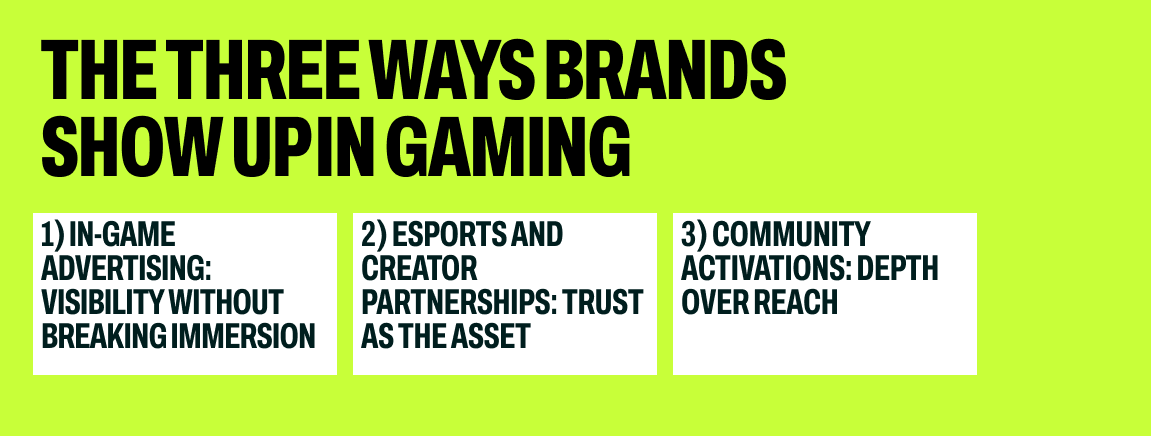
The three ways brands show up in gaming (and how to choose)
1) In-game advertising: visibility without breaking immersion
In-game ads work best when they’re designed around player experience first. The industry has been pushing toward better standards here - especially because intrusive formats can backfire fast.
A helpful reference point is the IAB’s Creative Guidelines and Best Practices in Advertising in Gaming, which focuses on balancing effective advertising with preserving player experience across game types and devices.
How to decide if in-game ads are right for you:
- Choose intrinsic/native placements if you want association and contextual credibility.
- Choose value-exchange formats (like rewarded) when the player clearly opts in and receives a meaningful benefit.
- Avoid “forced interruption” unless the game loop naturally has breaks that players already accept.
2) Esports and creator partnerships: trust as the asset
Esports and creators are often the fastest route to credibility because you’re entering through a trusted voice or a team identity. But that also means you’re renting trust, not buying impressions.
A strong partnership is built around:
- A repeatable content mechanic (series, segment, format), not a one-off shoutout
- A clear brand “job” (awareness, education, trial, community growth)
- Room for the partner to stay authentic (over-scripting is usually punished)
3) Community activations: depth over reach
Community programs tend to create stronger long-term memory and preference—but they require real effort: moderation, participation design, and follow-through.
Good activation patterns include:
- Challenges the community can remix (UGC loops)
- Events (watch parties, tournaments, meetups)
- Utility (tools, guides, perks, exclusive access)
If you can’t describe the community benefit in one sentence, it’s probably just a branded wrapper.
Strategy: how to build a brand presence players don’t reject
Start with context-fit (genre, platform, moment)
Let’s not forget gaming is not one channel. A brand can feel native in a sports/racing environment and feel completely wrong in survival horror. “Fit” is your first filter.
Design value before you design creative
The most reliable path to acceptance is value. That value can be:
- Entertainment (fun segment, creator format)
- Utility (tips, tools, performance perks)
- Access (drops, early looks, limited items)
- Rewards (fair value exchange)
The IAB gaming guidelines repeatedly anchor on avoiding disruptive implementations and setting consistency expectations (exits, audio, user control) so ads don’t degrade the experience.
Creative principles that keep gaming executions “native”
A few rules tend to separate smart brand presence in video games from “brand cringe”:
- Make it look like it belongs. Visual language should match the game environment, not a generic ad UI.
- Keep control obvious. Players hate feeling trapped by an ad layer.
- Use fewer words. Gaming is often high-attention; clarity beats copy length.
- Respect the community tone. Especially with creators—brand lines should sound like the creator could actually say them.
Measurement: what “success” looks like for brands in gaming
Don’t measure gaming like a banner campaign. Use a layered model:
- Delivery: reach, viewable exposure (where applicable), content output
- Quality: watch time, engagement, sentiment, community participation
- Business impact: search lift, site visits, sign-ups, sales, brand lift (if available)
The key is to pick one primary metric per objective, so your strategy doesn’t drift into “we did a lot” reporting.