



Marketing to gamers works best when you stop thinking in “ad placements” and start thinking in contexts: what people are doing, why they’re playing, and which communities shape their opinions. Gaming is mainstream and multi-generational - ESA reports 61% of Americans (190.6M people) play video games at least one hour per week—so the question isn’t whether to show up, but how to show up without feeling forced.
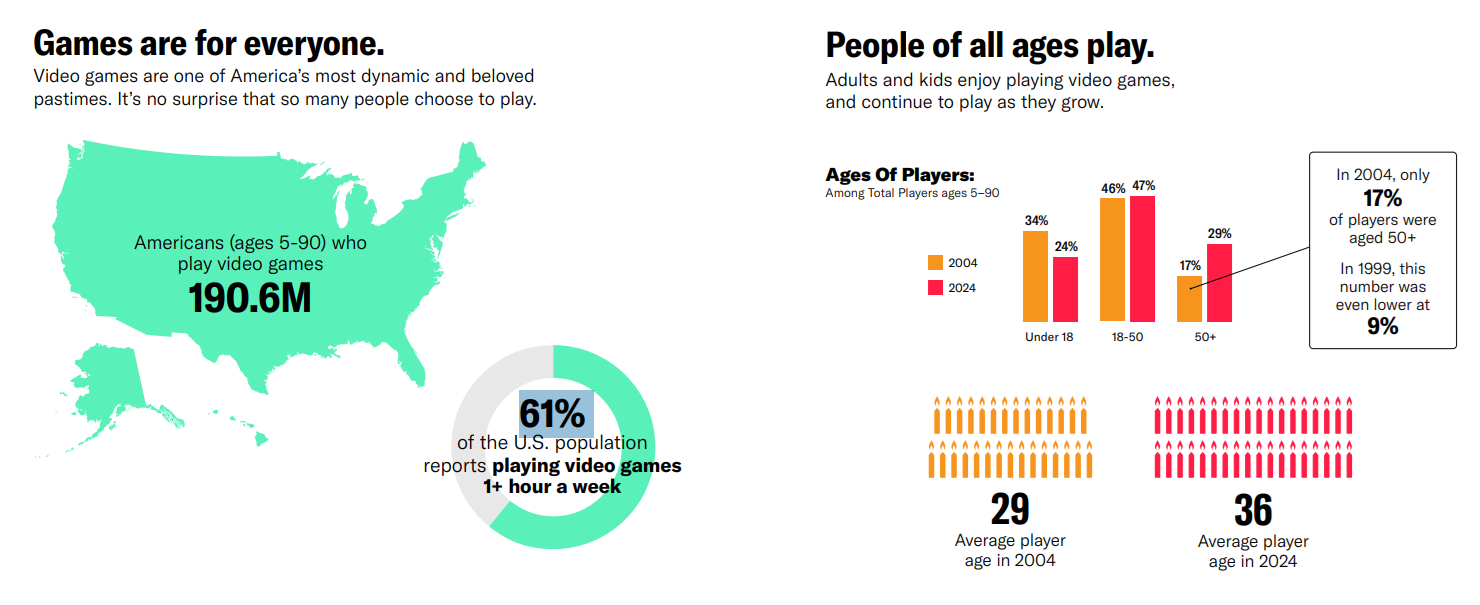
Source: Essential Facts About the U.S. Video Game Industry
Step 1: Understand gamers by motivation, not by stereotypes
Marketing to gamers starts with dropping the idea that gamers are one uniform audience. The same person may play a competitive shooter at night, a cozy game on weekends, and mobile puzzle games on commutes.
A useful segmentation lens is motivation + moment:
- Competitive mastery: cares about skill, fairness, progression, performance.
- Social connection: cares about co-op, friends, shared moments, humor.
- Discovery and story: cares about lore, exploration, aesthetics, immersion.
- Comfort and routine: cares about low-stress loops, vibe, consistency.
When you build messaging around motivation, channel decisions become obvious: mastery audiences tend to cluster around skill-focused creators and guides; social audiences live in short-form and community spaces; story audiences over-index on long-form video and reviews.
Step 2: Pick the right “entry point” into gaming culture
Brands typically enter gaming through three lanes. The best lane depends on whether you need credibility, scale, or participation.
Lane A: Creator-led discovery
Creators are often the fastest way to reach gaming audiences because they carry context and trust. The key is to brief creators around a format (a repeatable segment) instead of a one-off integration.
If your brief requires the creator to “act like a banner ad,” you’ll get banner-ad results: ignored, skipped, or mocked.
Lane B: In-game placements that preserve immersion
In-game advertising can work extremely well when it respects gameplay and user control. A practical reference point here is IAB’s Creative Guidelines and Best Practices in Advertising in Gaming (March 2024), which focuses on balancing advertising impact with player experience (clear exits, consistent behavior, and non-disruptive implementation).
The principle is simple: the more “in the moment” the player is, the more your brand must feel native—or opt-in.
Lane C: Community-first participation
Communities are where gaming decisions get validated. If creators drive discovery, communities drive “is this for us?” A brand that invests in community with a real benefit (tools, access, events, perks) tends to earn longer-lasting preference than a brand that only buys reach.
Step 3: Design value before you design creative
Most brand failures in gaming come from skipping the value question. Before you pick an ad format or influencer roster, define what the audience gets out of it.
Value can look like:
- Utility: tips, tools, setups, guides, quality-of-life benefits.
- Access: early looks, limited drops, behind-the-scenes, special participation.
- Rewards: fair value exchange (when opt-in is clear).
- Entertainment: content that stands on its own even without the brand.
If the value is unclear, the activation becomes “attention extraction,” and gamers are highly trained to resist that.
Step 4: Build an integrated funnel that matches gaming behavior
Gaming doesn’t behave like a linear funnel. People bounce between discovery, validation, and action depending on who they trust and where the conversation happens.
A practical structure for marketing to gamers:
- Discovery: creator content + paid amplification of the best-performing moments.
- Validation: community reaction (Discord, comments, duets, subreddits, chat moments).
- Action: landing/store experience that matches what the creator promised.
- Reinforcement: retargeting that uses the same cues players already saw (not generic brand assets).
The integration point most brands miss is the handoff between “great content” and “easy next step.” If a viewer has to work to find the product, you’ll lose the moment.
Step 5: Measure what matters (without flattening gaming into vanity metrics)
If you measure gaming like a standard display campaign, you’ll either over-credit the wrong channels or under-invest in the ones that build trust.
A better measurement model for marketing to gamers uses three layers:
- Delivery: reach, frequency, content output.
- Quality: watch time, repeat views, sentiment, community participation.
- Outcome: search lift, site actions, sign-ups, sales, brand lift studies.
Sources
- Entertainment Software Association — Essential Facts 2024 — data point on the scale of U.S. gaming audience (61% / 190.6M weekly players).
- IAB — Creative Guidelines and Best Practices in Advertising in Gaming (March 2024) — best practices for in-game advertising that protect player experience (e.g., consistency, clear exits, non-disruptive implementation).