


There are 3 billion mobile gamers in the world. Most FMCG marketing briefs do not account for a single one of them.
That gap is not a niche oversight. Mobile gaming is the largest consumer entertainment channel by player count, and it is where a significant portion of Gen Z and millennial attention now lives. According to Newzoo's 2025 Global Games Market Report, the global player base is projected to reach 3.6 billion in 2025, with mobile accounting for 3.0 billion of those players. Global mobile consumer spending hit $81.7 billion in 2025. These are not niche numbers.
What has changed over the last twelve months is not the size of the audience. It is the infrastructure. The mechanics that allow a brand to turn a gaming session into a purchase moment are now platform-native, not experimental. FMCG marketers who understand how those mechanics work will have access to purchase intent at a point in the day when their audience is fully focused, in a good mood, and voluntarily spending money.
What "shop-direct" actually means in a gaming context
Shop-direct mechanics are not banner ads placed inside a game. The distinction matters because confusing the two leads to bad briefs and wasted budgets.
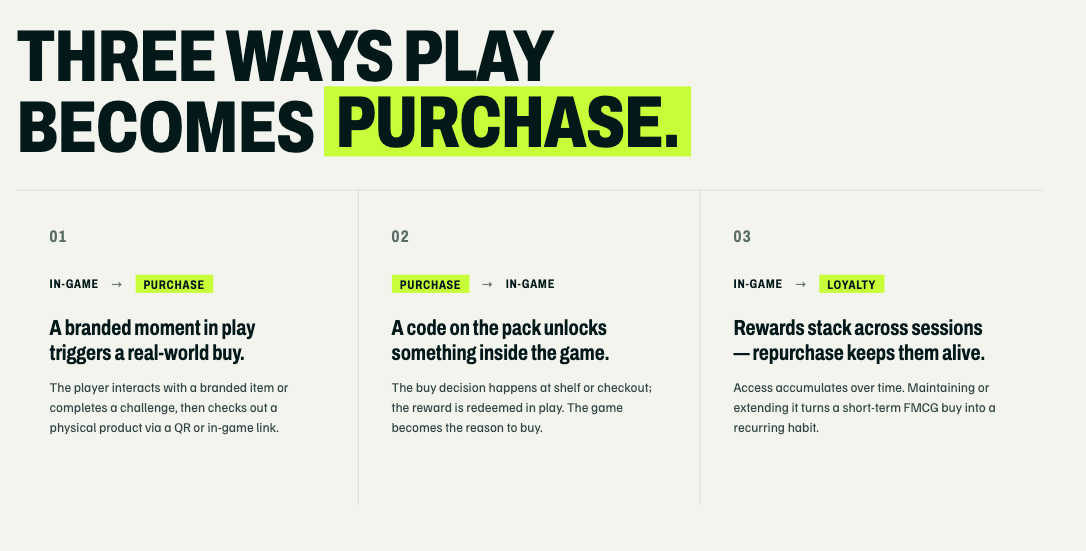
A shop-direct mechanic connects the gameplay loop directly to a commercial transaction, either digital or physical. There are three distinct layers:
In-game to purchase: the player interacts with a branded item or completes a challenge inside the game, then buys a physical product via a QR code or in-game link. The transaction is triggered by the game experience.
Purchase to in-game: a physical product includes a code that unlocks an in-game item or bonus. The purchase decision happens at shelf or checkout, but the reward is redeemed inside the game. The game is the reason to buy.
In-game to loyalty: rewards accumulate across multiple sessions, creating a recurring reason to purchase in order to maintain or extend in-game access. This is where short-term FMCG purchase becomes habitual.
None of these require the player to feel like they are watching an ad. The buy decision emerges from the play experience itself. That is what makes it structurally different from in-game advertising, and considerably more powerful for conversion-focused categories.
The infrastructure that made this possible in 2025
Two platform-level changes in the second half of 2025 moved in-game commerce from a brand experiment to a standard option for any marketer working with gaming partners.
In May 2025, Roblox launched Commerce APIs in partnership with Shopify, allowing eligible creators and brands to sell physical merchandise directly within their Roblox experiences. Players can discover and purchase physical products without leaving the platform. Creator studio Twin Atlas, one of the early adopters, saw six-figure commerce revenue in the first few weeks, with around 90% of orders placed through the in-game integration rather than any other channel.
In September 2025, Epic Games announced that Fortnite UEFN creators would be able to sell items directly from their islands starting December 2025. Since UEFN launched, players have spent 11.2 billion hours across 260,000 creator-made islands. Adding direct commerce to that engagement base is a significant commercial event.
For FMCG marketers, this means the question is no longer whether in-game commerce is technically possible. It is which mechanic to use, and when.
The formats that actually convert
Four mechanics have proven track records for FMCG categories. They differ in where they place the conversion moment.
Rewarded ads exchange a short attention window for in-game value: currency, extra lives, unlocked content. According to Bain & Company's Gaming Report 2025, via EMARKETER, 46% of gamers now make purchases based on in-game ads, up from 40% a year ago. Gamers respond positively to ads that are skippable, offer rewards, or are relevant to their interests. Rewarded formats score highest on all three. They work for FMCG because they can carry product messaging at a moment when the player is predisposed to complete the interaction.
Drops reward viewers for watching a gaming stream, not just for playing. The Allegro gamEXP campaign is the clearest proof of this mechanic at scale: players earned Smart! Coins by watching League of Legends, Valorant, and Teamfight Tactics streams, tracked automatically via a native Overwolf app. The campaign reached 19,884 active players, generated 94,647 completed challenges, and delivered +29pp ad recall and +12pp top of mind. Critically, the Smart! Coins were redeemable on Allegro's e-commerce platform, creating a direct bridge between gaming engagement and purchase behavior.
QR-on-pack turns physical product purchase into an in-game event. The consumer buys a snack, scans the code, and receives an in-game item or bonus. The game becomes a purchase driver at shelf, and the physical product becomes a ticket to the gaming experience. This mechanic works particularly well for snack and drink categories because the consumption moment and the gaming session often overlap.
Limited-edition virtual items bundled with physical purchase function similarly but with a higher perceived value. A branded in-game cosmetic, a character skin tied to a product, or a limited-time item unlocked only through purchase create urgency and exclusivity that straightforward loyalty programs rarely achieve.
How Allegro gamEXP built the model
The Allegro gamEXP campaign is worth examining in detail because it demonstrates what a well-constructed gaming commerce mechanic looks like end to end.
Allegro wanted to reach younger gamers authentically, not as an ad break, but as a genuine part of gaming culture. Rather than buying ad slots, Allegro built an ecosystem: a native app tracking challenge completions across three Riot Games titles, a Drops system rewarding viewers for watching partner streams, and a network of over 1,000 streamers who used the app themselves rather than reading scripts.
The results were measurable at every stage of the funnel. 200 million+ views across YouTube and TikTok. +12pp top of mind, +29pp ad recall, +16pp brand perception, +6pp brand affinity. And the purchase connection was direct: Smart! Coins earned through gaming were spent on Allegro's platform.
The mechanic made purchase-adjacent engagement trackable, and tied it to the moment when the player was most engaged. That is what FMCG brands need from gaming: not impressions, but a documented path from attention to purchase intent.
Matching the mechanic to the category
The right format depends on the consumption moment, not the product category alone.
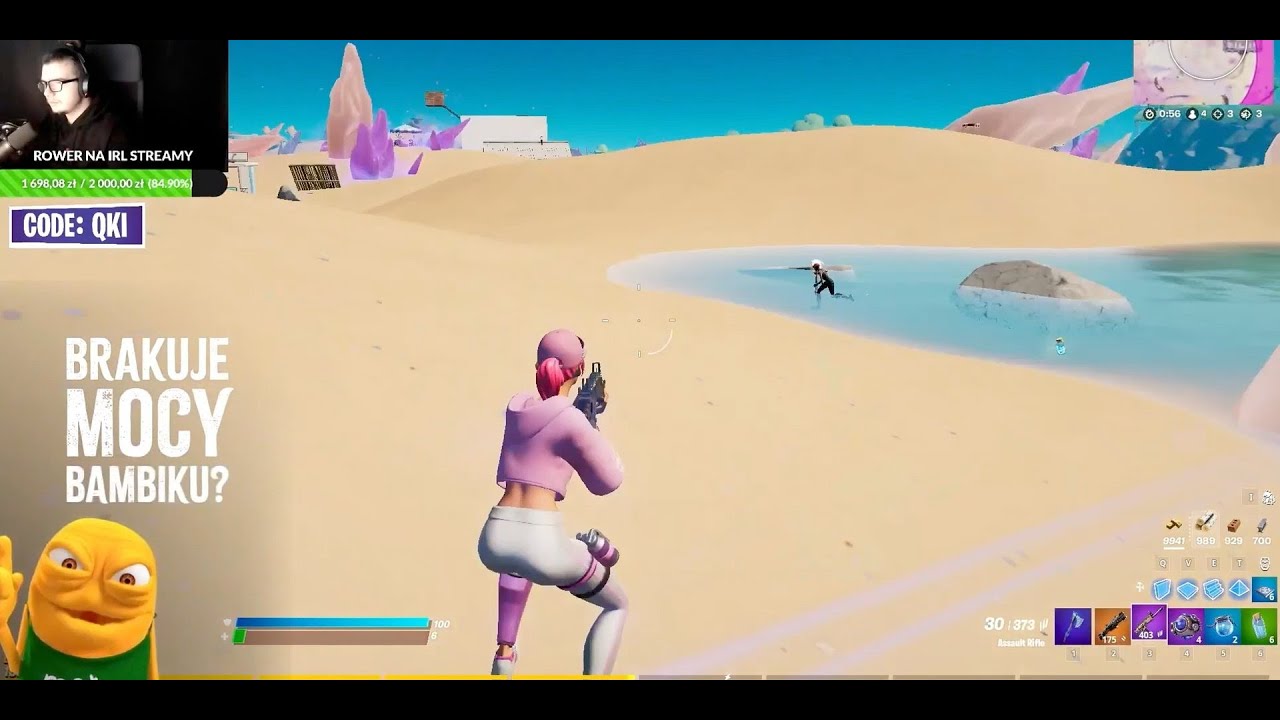
Snacks and drinks are natural fits for stream-moment mechanics. When a player's in-game energy drops or a streamer takes a break, a branded animation tied to a snack or drink product appears at the moment of highest relevance. New Game + built this mechanic for Danone's Danio campaign, using an AI system that read the live Fortnite gameplay feed in real time and triggered the Little Hunger character only when a player's in-game energy declined. Viewer reaction was curiosity, not irritation. QR-on-pack unlocks work in this category for the same reason: the consumption moment and the gameplay session are often the same moment.
Dairy and meal prep benefit from challenge completion rewards. Longer gaming sessions create more opportunities for challenge-based engagement, and products in this category are often consumed around mealtime, which coincides with natural gaming breaks. The Mlekpol Łaciate Protein+ Battle campaign ran a community tournament format around League of Legends, generating 1,012,768 total views and +17pp ad recall. Community-driven formats build brand consideration through repeated, positive exposure rather than a single impression.
Personal care fits avatar cosmetic integration. Skincare, haircare, and similar categories translate naturally to character aesthetics inside games. A limited-edition branded avatar item tied to a product purchase creates a collectible mechanic that works for audiences who already spend money on in-game cosmetics.
The question to ask before selecting a format is not "which category am I in?" but "when does my consumer encounter my product, and is there a gaming moment that matches it?"
What to track and what not to confuse with it
FMCG brands used to measuring TV GRPs or social CPMs often apply the wrong metrics to gaming activations. That leads to campaigns being assessed as underperforming when they are actually delivering the wrong output to the right audience.
The metrics that matter for in-game commerce mechanics are: purchase intent lift, ad recall (measured via brand lift study), challenge completion rate, QR scan and redemption rate, and repeat purchase rate across campaign periods. These connect to commercial outcomes.
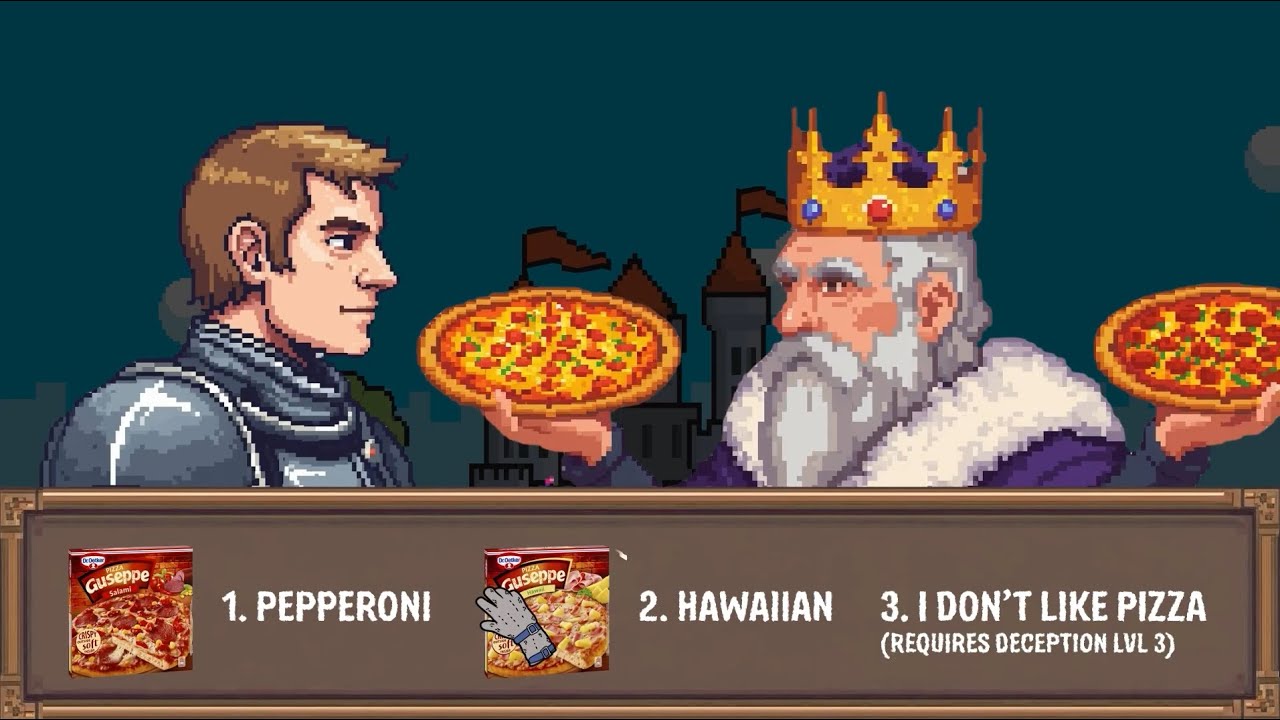
The metrics to treat carefully are: raw impressions, total views, and follower counts. They indicate reach, not purchase behavior. A campaign with 50 million views that moved zero purchase intent is not a successful FMCG campaign. A campaign with 20,000 active players and +11pp purchase intent, as Dr. Oetker achieved with Pizza Guseppe, is.
The strongest single signal across FMCG gaming campaigns is whether players return. Repeat engagement with a branded mechanic indicates that the brand has become part of the player's gaming routine, which is a more durable indicator of purchase consideration than any single interaction.
What to brief a gaming partner on before launch
Most gaming campaigns underperform because the brief does not specify the commercial mechanism. A brief that says "reach gamers aged 18–30 with positive brand messaging" will produce awareness metrics. It will not produce a buyer journey.
Before briefing a gaming partner, an FMCG marketer needs three things defined:
The purchase moment. What triggers the transaction? Is it a game event, a stream interaction, a challenge completion, or a physical product scan? The mechanic should be built backwards from that moment, not forwards from a media plan.
The value exchange. What does the player receive that justifies the action? The value has to be real within the game context. In-game currency, exclusive items, or access to otherwise-locked content all work. A discount code alone rarely does.
The measurement plan. What does conversion look like for this product category, and how will it be measured before, during, and after the campaign? Brand lift studies should be commissioned before launch, not as an afterthought.
A practical pre-launch checklist:
- Platform identified (Roblox, Fortnite, mobile game, Twitch Drops) and matched to target audience
- Mechanic defined and matched to consumption moment, not just to platform reach
- Physical and digital reward both specified before briefing the creative team
- Measurement method agreed with the gaming partner before the campaign goes live
- KPIs separated by funnel stage: awareness metrics, consideration metrics, and conversion metrics tracked independently
Key takeaways for FMCG marketers
- In-game commerce infrastructure is now platform-native on Roblox and Fortnite. The technology barrier that made this category feel experimental has been removed.
- 46% of gamers make purchases based on in-game ads. The audience is predisposed to commercial interaction when the format matches the context.
- The mechanic determines the output. Drops drive trackable consideration. QR-on-pack drives purchase at shelf. Rewarded ads drive attention and recall. Choose the mechanic by mapping backwards from the commercial moment.
- The strongest FMCG gaming campaigns do not look like advertising to the player. They look like part of the game. Allegro's gamEXP is the reference point: built as an ecosystem, measured at every stage of the funnel.
- Brief the purchase moment first. The creative and media plan follow from that decision.