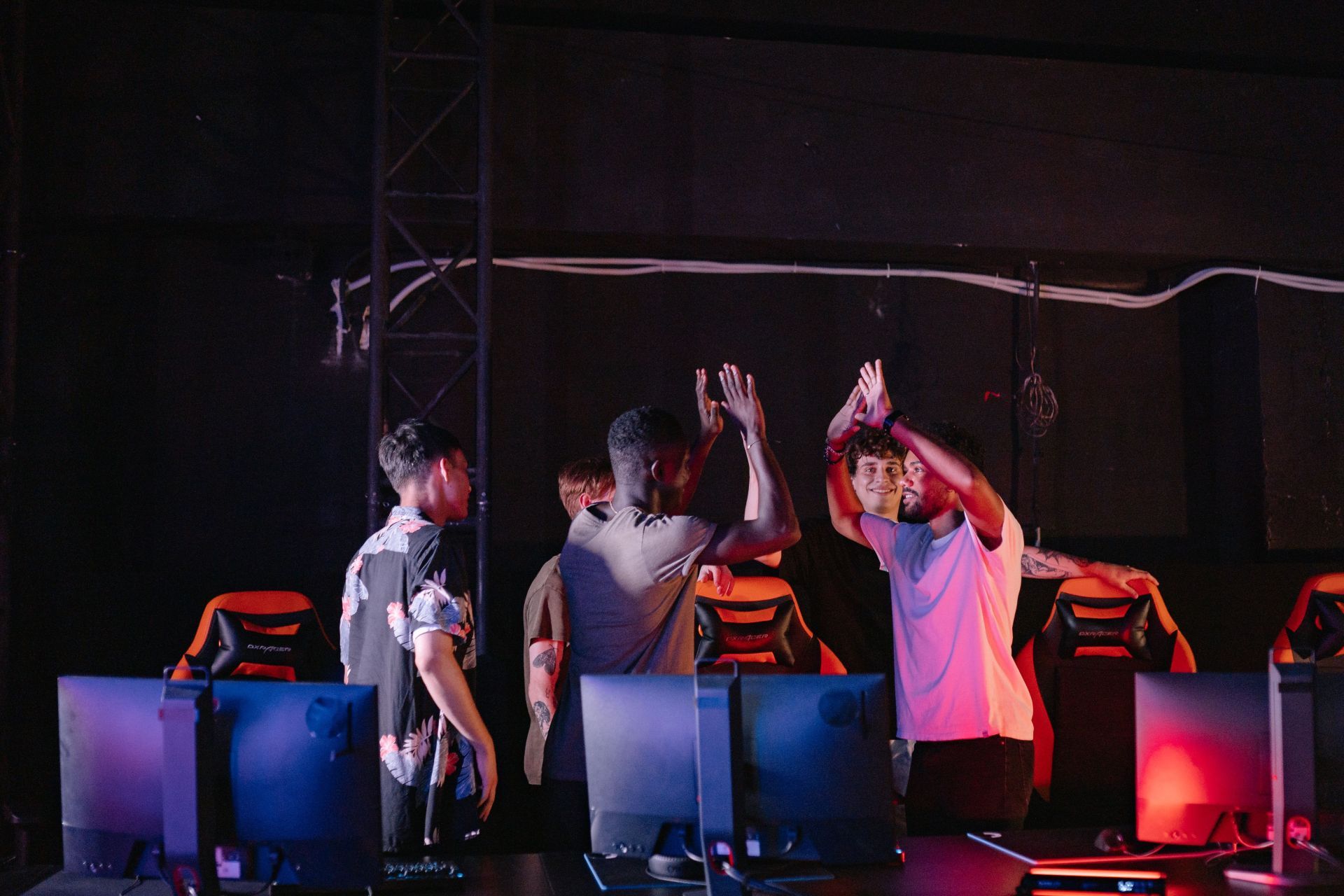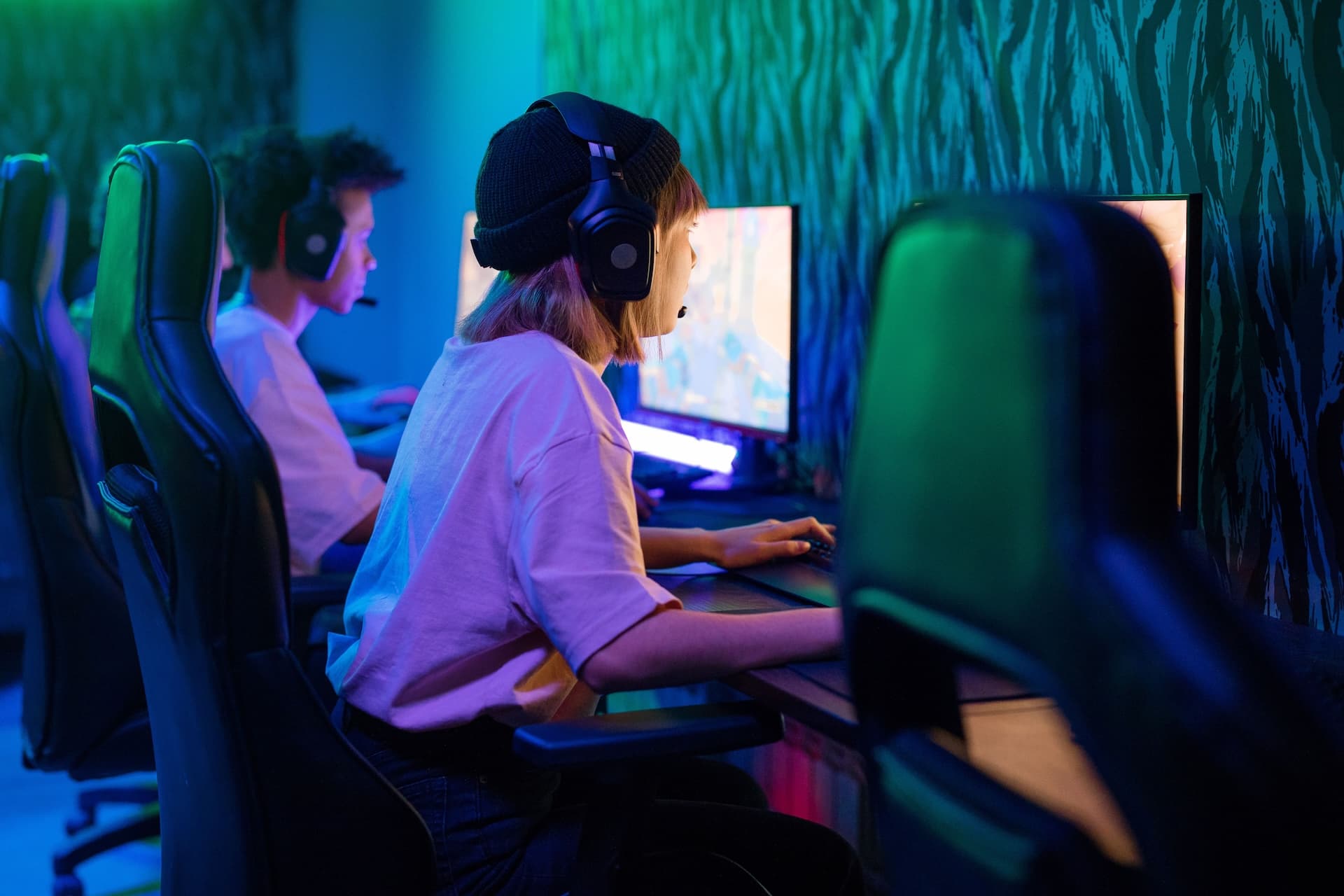



Gaming marketing trends are no longer a "nice-to-have" slide in a deck. They are reshaping how brands buy media, brief creative, and measure outcomes-because gaming sits where attention actually is: in play, in livestreams, and in chats that never stop moving. The numbers speak for themselves: 93% of livestream viewers also play games, and over 73% actively participate in chat while watching. These two figures explain why gaming advertising trends look different from most digital channels. Nobody scrolls past content here-people are inside the action, reacting in real time, calling out every play in chat. This isn't an impression. It's participation.
Why gaming advertising trends matter more in 2026 than they did in 2023
Gaming is not shrinking into a niche. Newzoo's Global Games Market Report 2025 puts global revenues at $188.8B in 2025, with a player base of approximately 3.6 billion-not millions, billions. And yet brands still under-invest relative to the time audiences actually spend with games.
Dentsu's 2024: State of Gaming Report points out that gaming ad spend sits below 5% of total mix, despite the channel's cultural and time-spent footprint. That gap is exactly why gaming advertising trends keep accelerating: budgets follow outcomes, and outcomes follow attention.
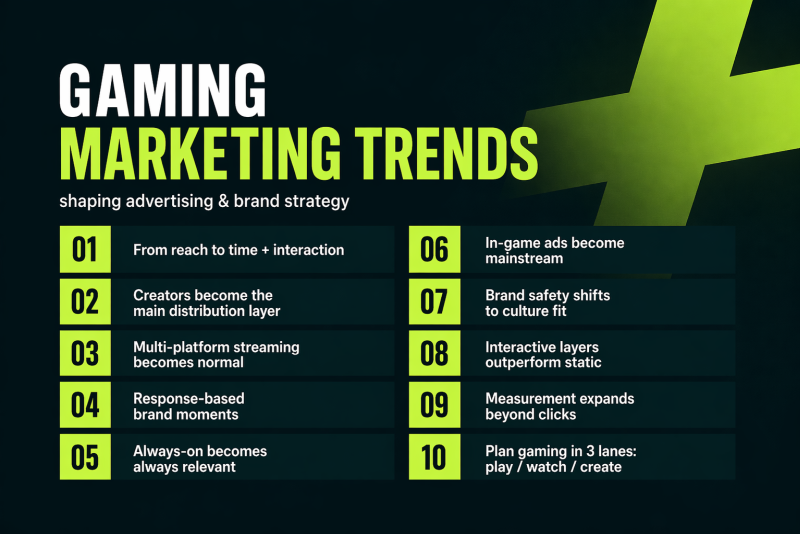
10 gaming marketing trends shaping advertising and brand strategy
Below are the gaming advertising trends that most directly change how to plan campaigns-and what usually breaks when teams treat gaming like "just another placement."
1) From reach to time + interaction
One of the biggest gaming advertising trends is the shift from passive exposure to time spent with content and the number of actions people take while a brand is present. Livestream chat, votes, prompts, and creator-led moments create measurable participation-not just impressions. If your KPI set is still "views only," you will miss exactly why gaming marketing trends drive stronger lift: the audience is doing something while the message appears, not tuning it out.
2) Creators become the main distribution layer
Gaming advertising trends increasingly start with the creator, not the platform. Co-streaming and creator commentary can outperform "official" broadcasts-especially in esports, where community voices often carry more weight than league-produced feeds.This is also where video game marketing trends converge with broader creator marketing: you plan for talent-led delivery, not only for media placement.
3) Multi-platform streaming becomes normal-within platform rules
Simulcasting is no longer fringe. Twitch's Terms of Service explicitly allow multi-platform streaming, provided creators maintain at least the same viewer experience on Twitch, don't push viewers to leave, and don't merge cross-platform chats or features during the simulcast.For brands, this matters because gaming advertising trends now include "one live moment, many surfaces." A single creator activation can reach different discovery algorithms at once-if the plan is built with those rules in mind.
4) Brand moments that respond to what's happening-not interruptions
In gaming, the fastest way to lose goodwill is to interrupt flow. So one of the most consistent gaming advertising trends is "response-based" creative: the brand shows up when something meaningful happens-a clutch play, a win/loss, a tense standoff, a chat spike, a natural break in the action.This is why overlay formats tied to gameplay moments and creator context keep growing inside video game marketing trends. The same logic applies to non-endemic brands too: be present at a moment people already care about, not between moments they're trying to get back to.
5) "Always-on" evolves into "always relevant"
Brands often ask for constant visibility. Gaming marketing trends push the opposite: be present often, but only when it fits the moment.A practical example is rotating copy on overlays-short lines that change across impressions-instead of hammering the same slogan until it becomes background noise. It's one of the simplest ways to keep frequency from turning into fatigue.
6) In-game ads mature into a mainstream media line item
Gaming advertising trends are not only about streams. In-game advertising is becoming a standard part of planning, especially for brands that need broad reach in a premium context. IAB's Changing the Game report shows 86% of surveyed advertisers say games advertising is of growing importance to their company, and 40% planned to increase spending in 2024. The same report frames games advertising as a channel that supports outcomes across the full funnel.If your team still treats in-game ads as "experimental," you may be behind where the market already is-not ahead of it.
7) Brand safety shifts from "avoid risk" to "fit the culture"
A lot of gaming advertising trends can be summarized as: brand safety isn't just about avoiding bad content-it's about avoiding cringe.Dentsu's release stresses authentic engagement with gaming communities as a core requirement. In practice, that means choosing creators whose tone actually matches your product, briefing for how the message should sound in-stream, and building creative that respects the humor, tempo, and community norms of each space.
8) Interactive layers outperform static layers-when they're simple
Interactivity isn't a gimmick in gaming; it's the native language. The best-performing executions usually keep it to one action, one payoff: a vote, a chat keyword, a quick choice that the community can react to together. In the Cheetos "Chepard Game" activation, viewers generated 50,000+ interactions and 3.214M views, with measured lifts in brand perception. This is one of those gaming advertising trends where the creative idea and the media format are the same thing.
9) Measurement expands beyond clicks-but stays concrete
Gaming marketing trends push measurement into two buckets. First, direct response where it fits: CTR, landing page clicks, codes, store visits. Second, brand impact where that's the real goal: recall, affinity, top-of-mind awareness.IAB's research positions games advertising as effective across the purchase journey, including consideration and advocacy. The practical takeaway: decide what you're measuring before you pick the format. Forcing every gaming campaign into "click or fail" logic means leaving most of the channel's value on the table.
10) "Gaming" planning becomes three-lane planning: play, watch, create
The clearest way to operationalize gaming advertising trends is to stop treating gaming as one channel. Plan it as three distinct environments:
- Play - in-game placements, brand maps, brand items
- Watch - livestream overlays, co-streams, esports broadcasts
- Create - creator content, clips, shorts, community remixes
Dentsu highlights how gaming plans now span touchpoints across playing, watching, and creating simultaneously. This three-lane framing makes video game marketing trends much easier to translate into actual budgets and briefs.