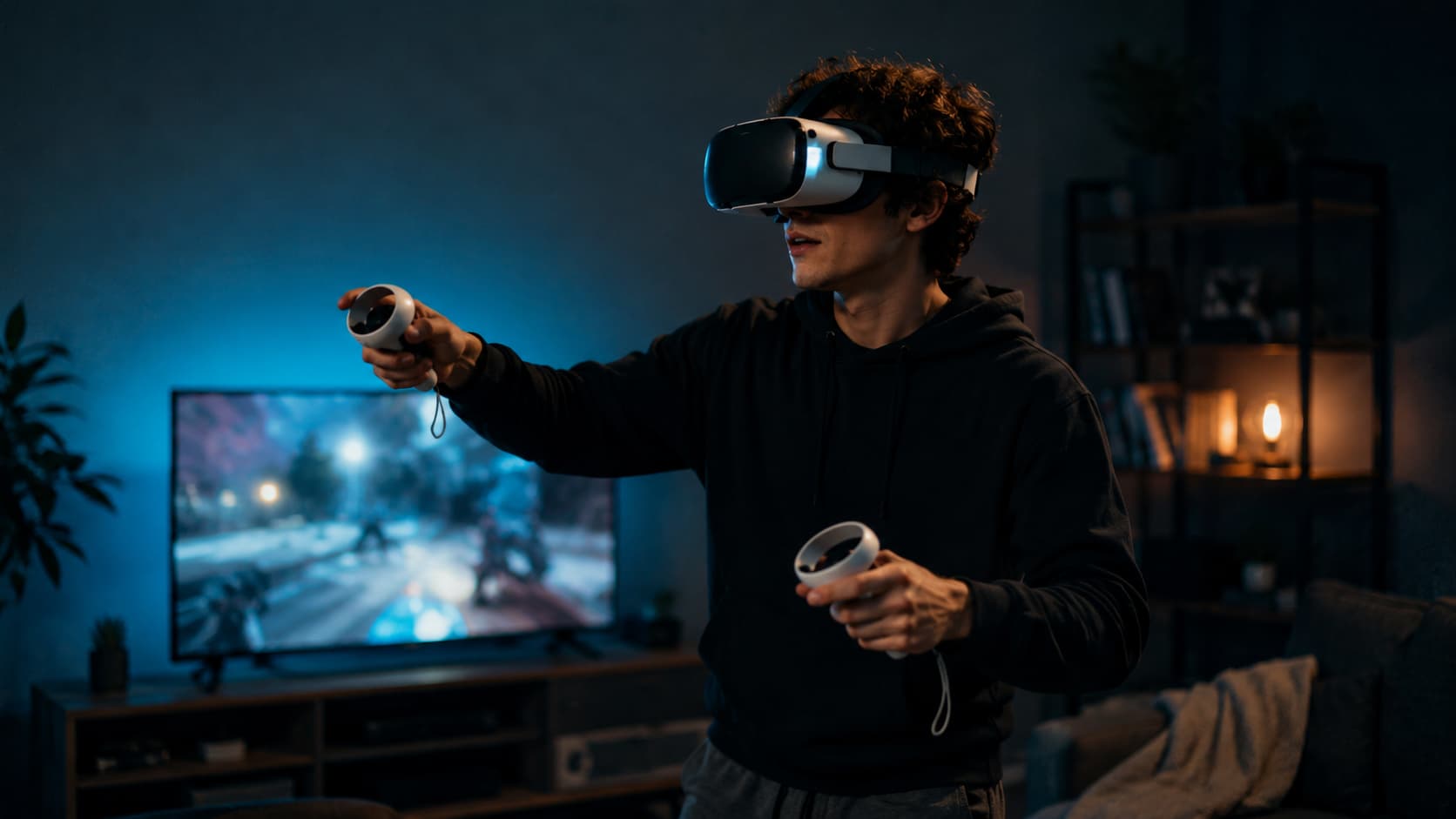



"Immersive" has become the word brands reach for when they want to signal ambition without specifying what they actually mean. It appears in briefs for VR installations, AR filters, branded Fortnite maps, Twitch overlays, and physical pop-up experiences with spatial audio. When a term describes all of those things, it stops being useful for making decisions.
The question that actually matters - the one the word "immersive" is supposed to answer - is simpler: is the audience fully engaged with the brand's presence, and did they choose to be? That question has a specific answer in gaming. It is not the answer most briefs expect.
What VR is, and what it isn't as a marketing channel

The VR gaming market is projected to surpass $90 billion by 2030, according to market analysts tracking the sector. The technology is real, the growth is real, and the experiences it enables are genuinely impressive.
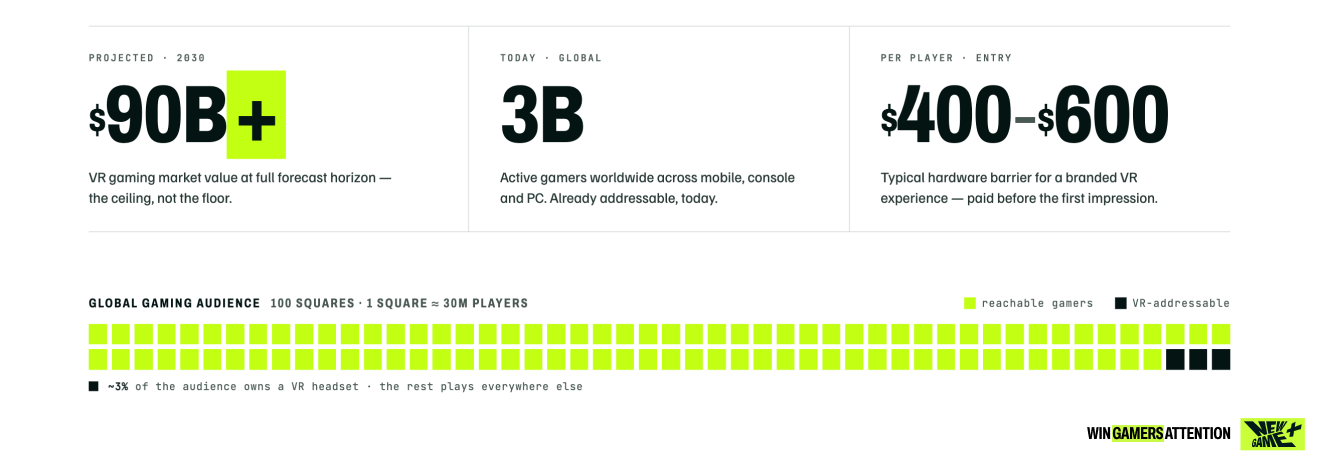
But VR headset ownership remains low relative to the broader gaming audience. The majority of the world's 3 billion active gamers do not own a headset. A branded VR experience that requires a $400–$600 device to access reaches a fraction of the audience a well-executed streaming campaign reaches - and it reaches them in an ecosystem where brand presence is still figuring out its conventions.
VR is the right channel in specific circumstances: the brand has a product that genuinely benefits from spatial simulation (automotive, real estate, travel), the target audience is already in the VR hardware ecosystem, and the budget justifies a niche reach with high engagement depth. Outside those conditions, it is a technology demo with an audience problem.
AR: more accessible, less deep
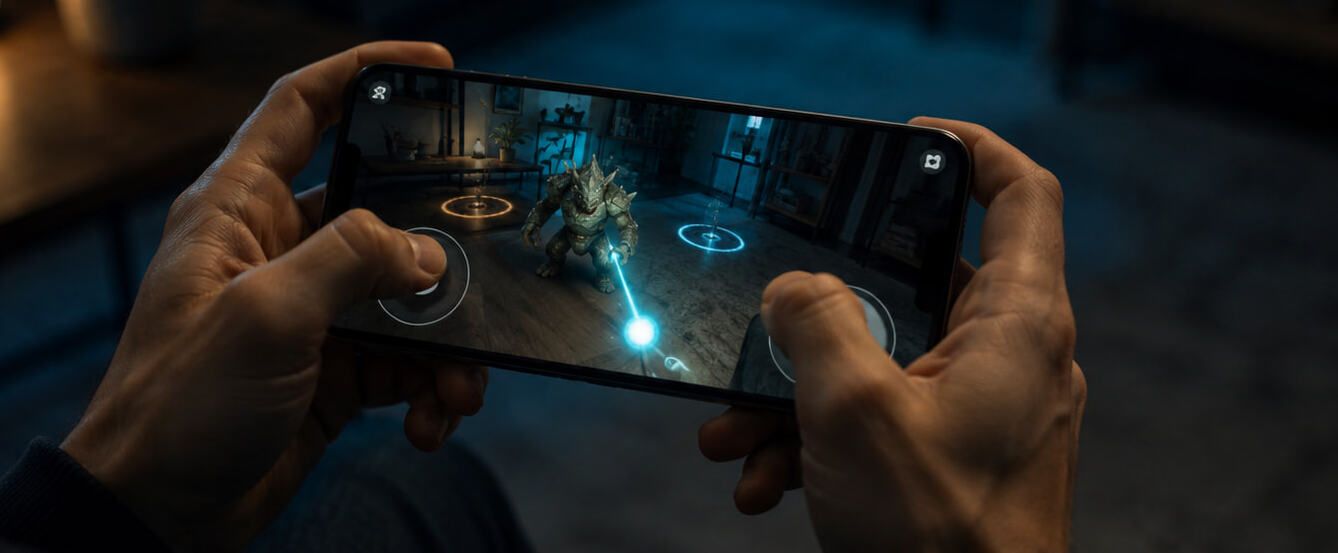
Augmented reality overlays digital content onto the real world - Snapchat filters, furniture placement apps, location-based activations. It is more accessible than VR because it runs on devices people already own. It is also shallower, because it sits on top of the real world rather than replacing it.
In gaming specifically, AR's natural home is in the space around gaming: social content generated by players, physical retail activations, mobile gaming contexts. It does not typically live inside the gaming session itself. A player in the middle of a competitive match is not reaching for an AR filter.
The immersive media market overall is projected to grow from $46.4 billion in 2025 to $421 billion by 2035, according to Roots Analysis data reported by WebProNews. Market size growth is real. But market size growth is not the same as relevance to a specific brand's specific gaming audience - and confusing the two leads to briefs that chase technology trends rather than audience attention.
Gaming is already immersive - by definition
The most important thing to understand about immersive marketing in gaming is that gaming audiences are already immersed. This is what makes the channel structurally different from every other media environment.
The average gaming session runs from 30 minutes to several hours. During that time, 73% of session time is spent in high concentration - the player is not multitasking, not passively receiving content, not available to be interrupted, according to research from McKinsey and Dentsu referenced in New Game +'s gaming marketing analysis. This is a lean-forward medium. The player chose to be here, is actively participating, and is paying a quality of attention that television, social media, and pre-roll video cannot manufacture.
Compare the average TikTok view time of 3.3 seconds to the PKO Bank Polski Fortnite map, where players spent an average of 26 minutes per session inside a branded experience - voluntarily, without a skip button, in a state of active engagement. The technology was Fortnite Creative. Not VR. Not AR. A game engine the players already had installed on their devices.
Immersion came not from the hardware delivering the experience, but from making the brand the world the player chose to live in for 26 minutes.
What the PKO Bank case actually demonstrates
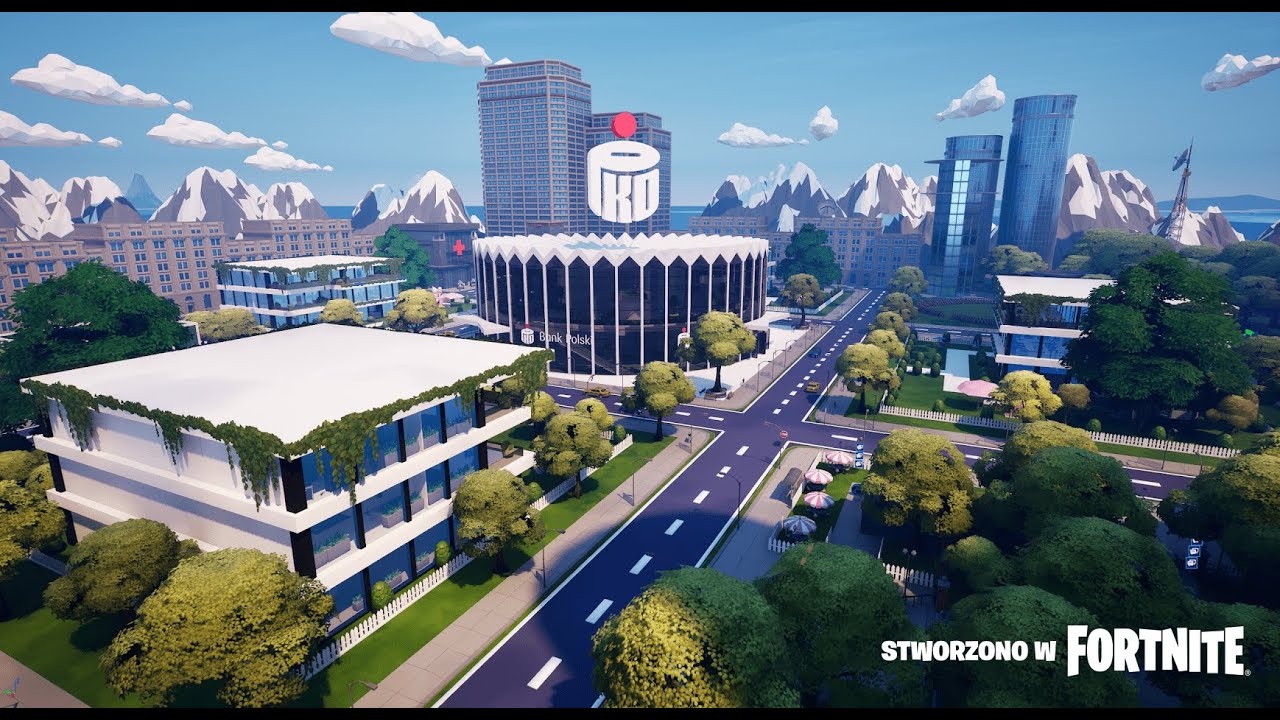
PKO Bank Polski had a specific problem: only 28 out of every 1,000 ad impressions successfully reach people aged 13–17 through standard channels. The brief required reaching Gen Z with financial education without triggering the resistance that kills most financial advertising aimed at young audiences.
The solution was a custom Fortnite map - PKO Rotunda - where players opened virtual accounts, managed their own plots, ran businesses, and completed side quests that taught financial basics. The bank was not advertised inside a game. The bank was the game.
The case study documents: 590,000 Fortnite map views, 9 million content views, 26 minutes average playtime per player, 7+ months of total accumulated gameplay time. That is the attention depth immersive marketing promises. It was delivered through a game engine on a PC or console, accessible to anyone with a Fortnite account.
What the Danone case adds
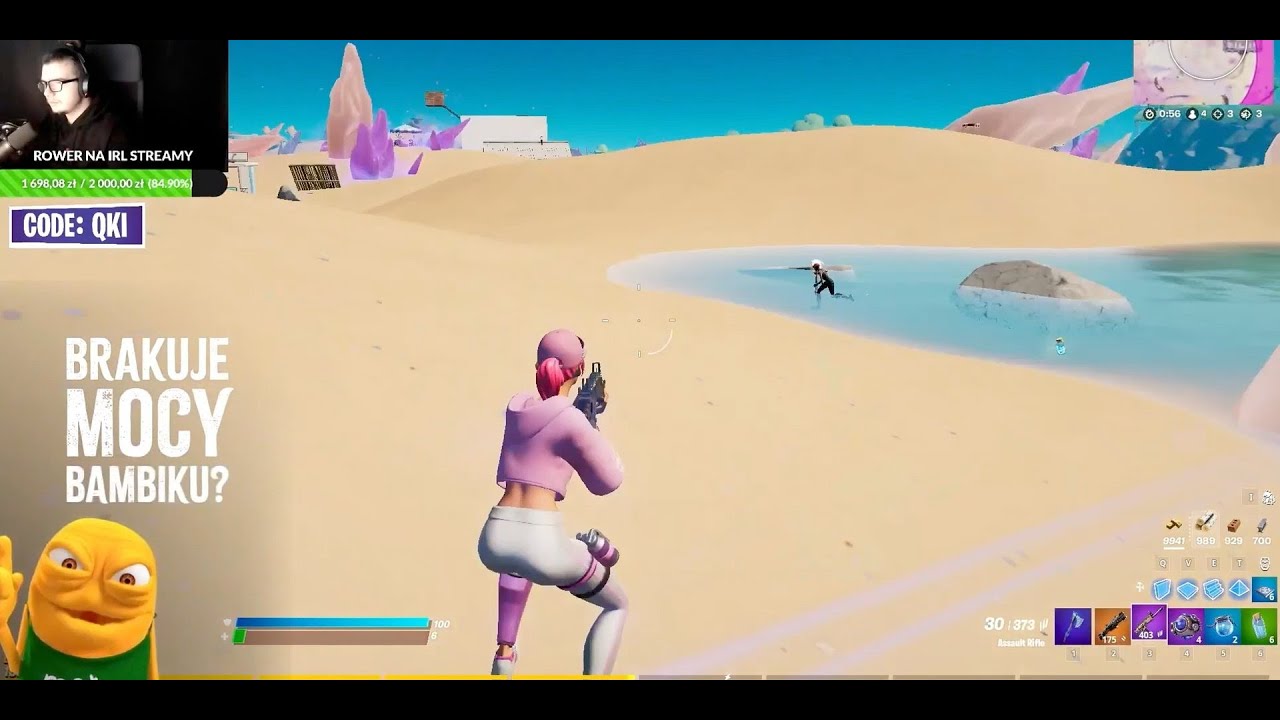
If the PKO Bank case shows what sustained immersion looks like, the Danone Danio campaign shows what precision immersion looks like.
Danone needed to introduce its "Little Hunger" character to Gen Z gaming audiences without triggering the ad resistance that kills brand characters in gaming contexts. The execution used an AI system to read the live Fortnite gameplay feed in real time. When a player's in-game energy dropped - a specific, measurable game state - a contextually relevant Little Hunger appearance was triggered with a scenario-specific comeback line.
100% trigger precision. 650,000 views. The viewer reaction, documented in chat, was curiosity: "How does he know you're losing energy right now?"
That reaction is what earned immersion produces. Not irritation at an interruption, but genuine engagement with something placed at the right moment. The Danone case study describes this as the first AI gameplay analysis system in Poland. The technology was the mechanism, not the experience. The experience was brand presence that felt appropriate because it arrived at the right moment.
When VR and AR do make sense
Precision matters here. VR is not a bad channel - it is a specialized one, appropriate under specific conditions.
Use VR when: the brand's product or experience genuinely benefits from spatial simulation and the target audience owns the hardware. Automotive test drive experiences, real estate walkthroughs, and travel previews have clear VR use cases because the experience itself translates directly to the product category.
Use AR when: the activation lives in the space around gaming rather than inside the gaming session. Physical retail, events, and mobile gaming contexts where players are already between sessions are natural AR territory.
Use in-game integration - Fortnite, Roblox, streaming overlays, custom builds - when: the objective is broad reach, the target audience is in the gaming ecosystem, and the goal is attention depth rather than technology novelty. No hardware barrier. No installation required. Access to 3 billion players on devices they already own.
The three questions that replace the technology debate
Most briefs that include the word "immersive" would be better served by answering three questions.
Where does the target audience spend focused attention within gaming? Not "in gaming generally," but specifically - which game, which platform, which format, which moment in the session. The answer to this question determines whether a brand's presence is placed where attention exists or where it needs to be manufactured.
Can the brand add something to that experience - gameplay, reward, entertainment, contextual relevance - rather than interrupt it? The PKO Bank map was the game. The Danone character arrived at the right moment. Neither interrupted anything. Both earned the attention they received.
What does success look like in metrics the platform can actually measure? If the answer is VR headset impressions in a market where 5% of the target audience owns a headset, the metric is not measuring what the brief intends. If the answer is session time, return visits, and community content generated, the metric reflects what actually happened.
These three questions produce better briefs than any technology trend report about immersive marketing. They shift the conversation from "which technology delivers immersion" to "where does our audience already have it, and how do we earn a place there."
Key takeaways for marketers
- Immersion is a state of attention, not a technology category - and gaming audiences are already in that state when they play
- VR is a specialized channel appropriate for specific products and audiences who own the hardware; it is not a mass-reach gaming marketing solution
- The PKO Bank Fortnite map delivered 26 minutes of average session time using Fortnite Creative - no VR, no AR, no hardware barrier
- The Danone AI gameplay analysis campaign shows what contextual precision looks like: brand presence that earns curiosity rather than irritation
- The questions that matter: where is the audience's attention, can the brand earn a place there, and can that be measured?