


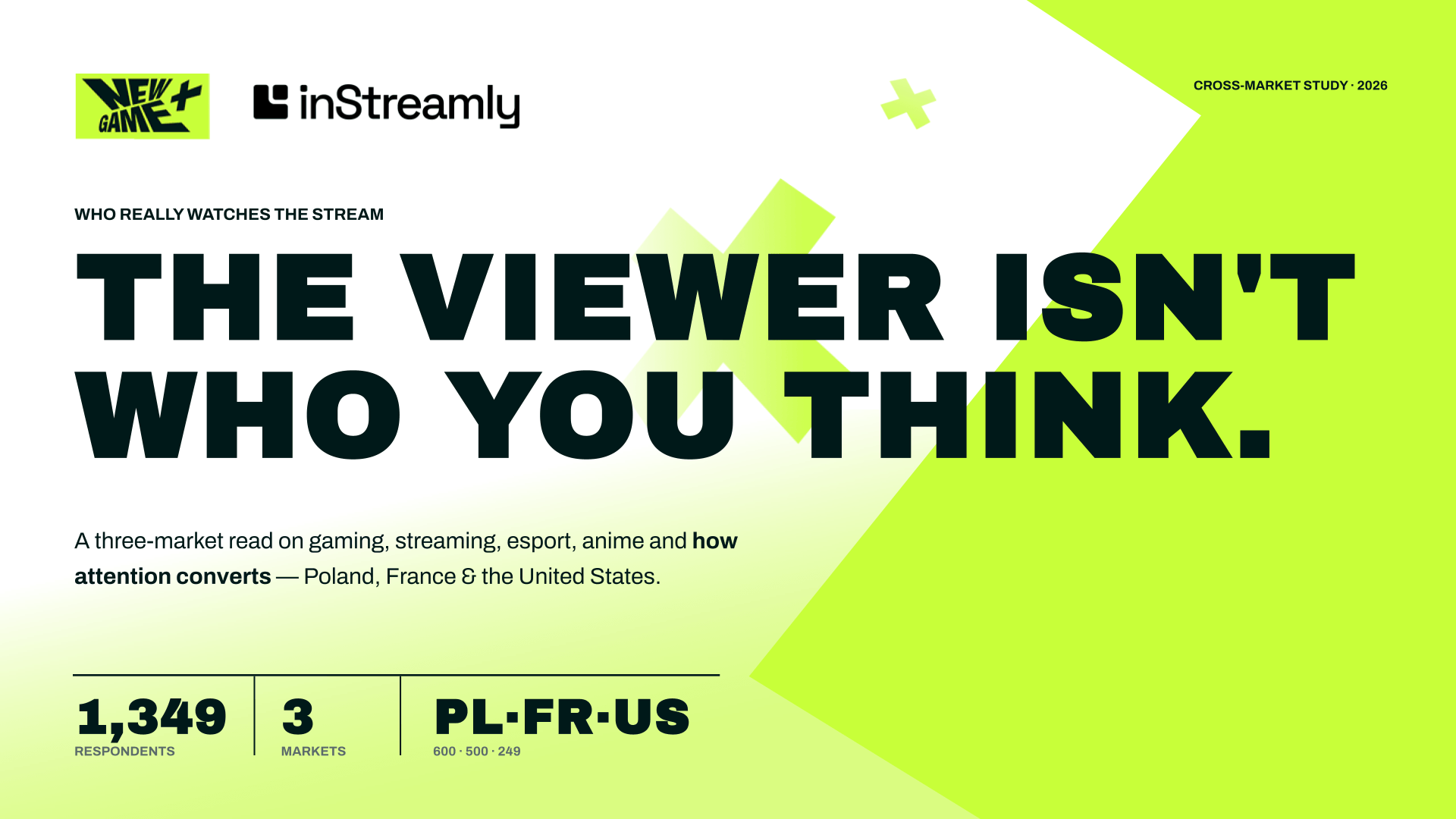
In the fast-evolving digital landscape, gaming and live streaming have shifted from niche subcultures into dominant forces of global entertainment. Yet, many brands and marketers still operate on outdated assumptions. To uncover the real behavior of today’s gaming audience, New Game +, in collaboration with inStreamly, conducted a comprehensive study across three key markets: Poland, France, and the United States.
Instead of just looking at isolated data points, we connected the dots to understand the cultural identity, attention economics, and purchasing power of stream viewers. The results challenge the industry status quo and reveal a highly engaged, mature, and commercially potent ecosystem.
Here are the key shifts every modern marketer needs to understand.
The age paradox: Gaming is no longer a youth medium
The most compelling and counter-intuitive finding of our research completely shatters the stereotype of the "teenage gamer." Across all three markets, gaming and streaming intensity actually increases with age.
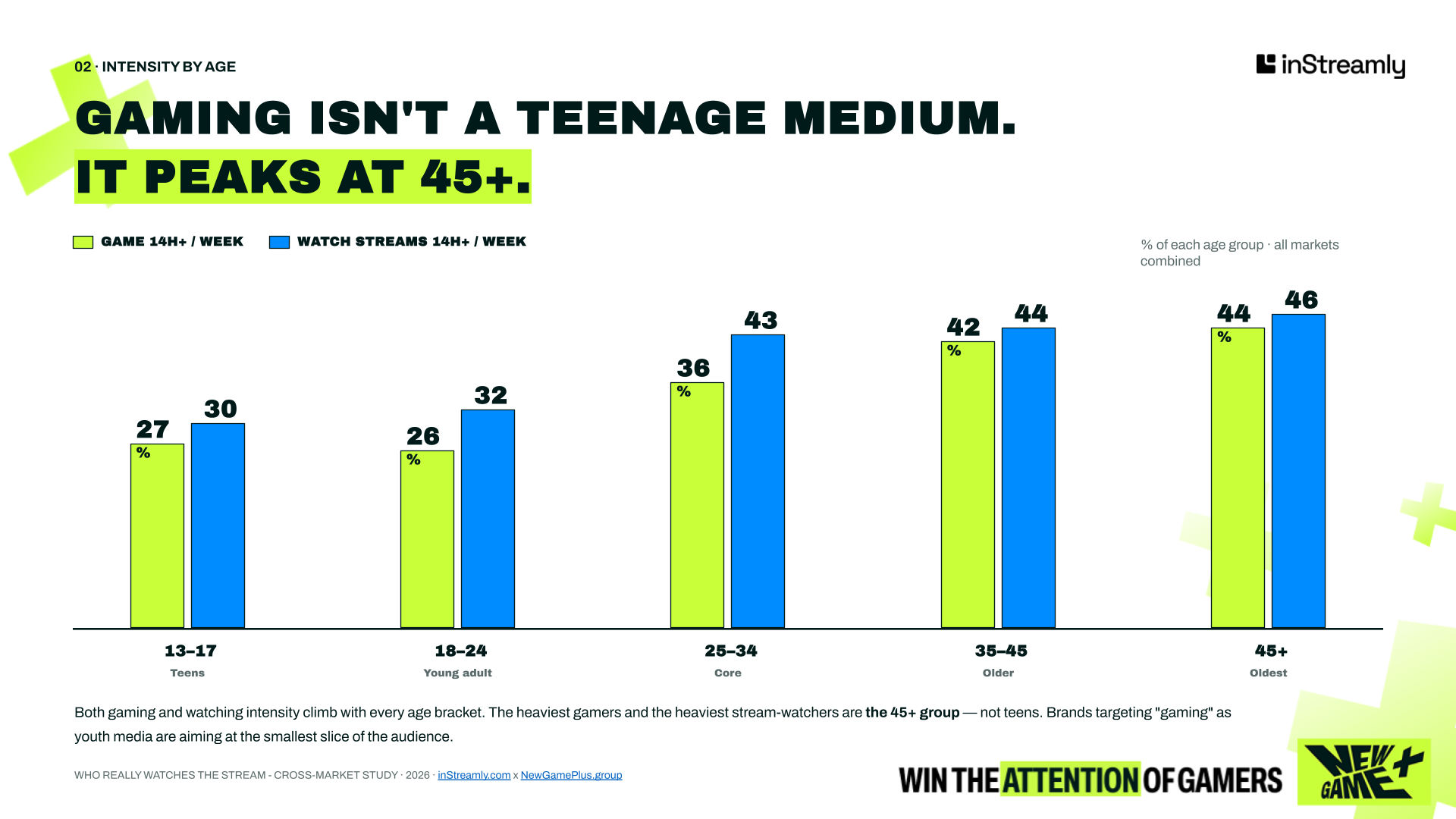
When looking at "heavy gamers" (those playing over 14 hours a week), the 45+ demographic leads the pack, while teenagers (13-17) consistently show the lowest percentage of heavy players in Europe. A similar pattern emerges in streaming consumption: in the US, a staggering 61% of the 45+ demographic are heavy stream viewers (14h+/week).
The Takeaway: Brands targeting "gaming" as a purely youth-centric medium are missing the majority of the audience—and arguably the segment with the highest disposable income.
The myth of the shattered attention span
We live in an era dominated by TikTok-style, short-form content, leading many to believe that modern audiences cannot sustain focus. Our data proves the exact opposite when it comes to live streaming.
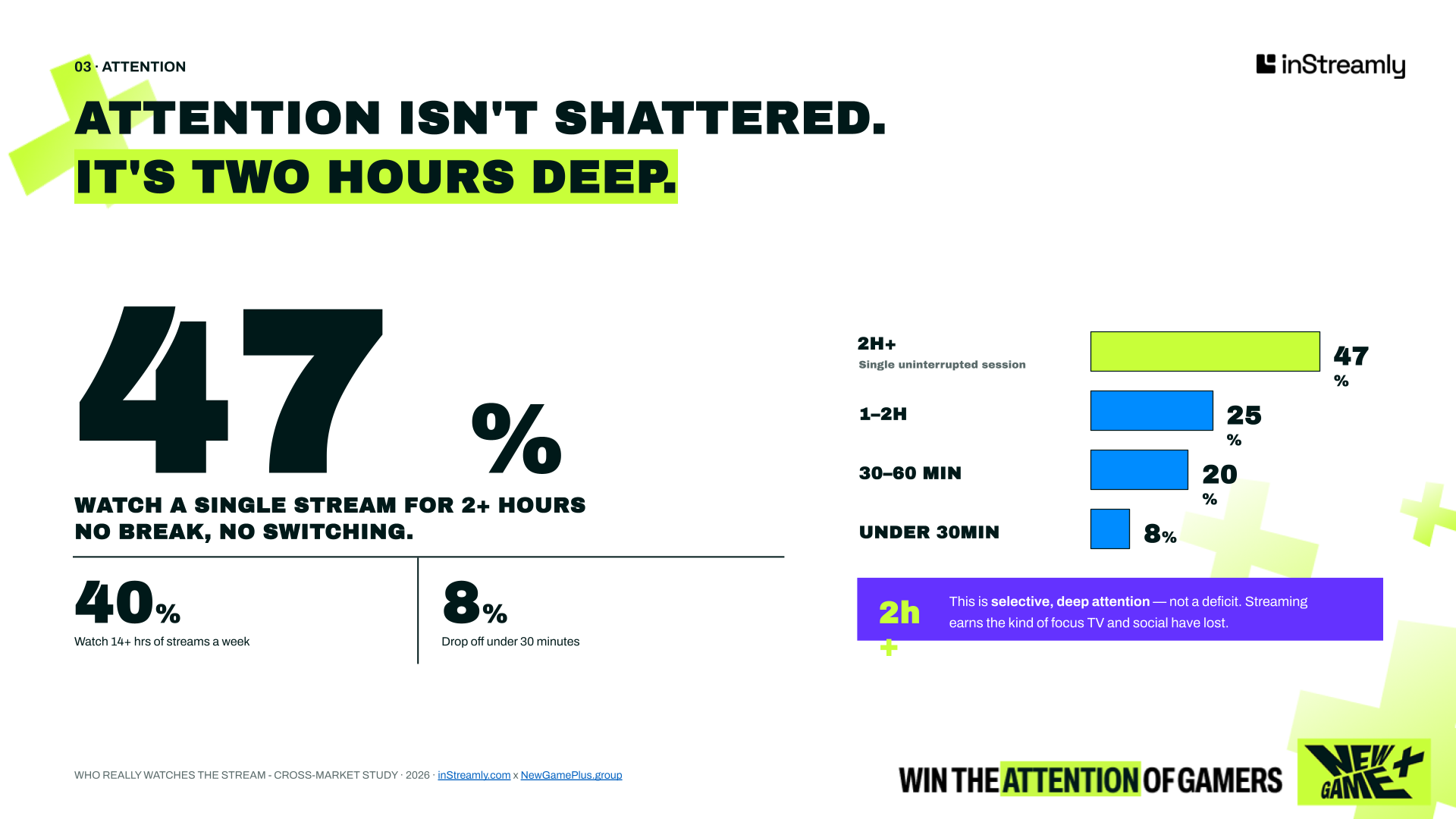
An incredible 40% of the entire sample spends more than 14 hours a week watching streams. More importantly, this attention is deep and uninterrupted: nearly half of all respondents (47%) watch a single stream for over two hours in one sitting without switching channels.
The Takeaway: This is not a fragmented, accidental audience. Stream viewers display selective, deep attention. They deliberately choose to spend hours with a creator, offering brands a rare window of high-quality engagement that traditional TV can no longer guarantee.
Streaming is the ultimate performance channel
For years, gaming sponsorships were viewed primarily as brand awareness plays. It’s time to rewrite the playbook: streaming is a powerhouse performance and conversion channel.
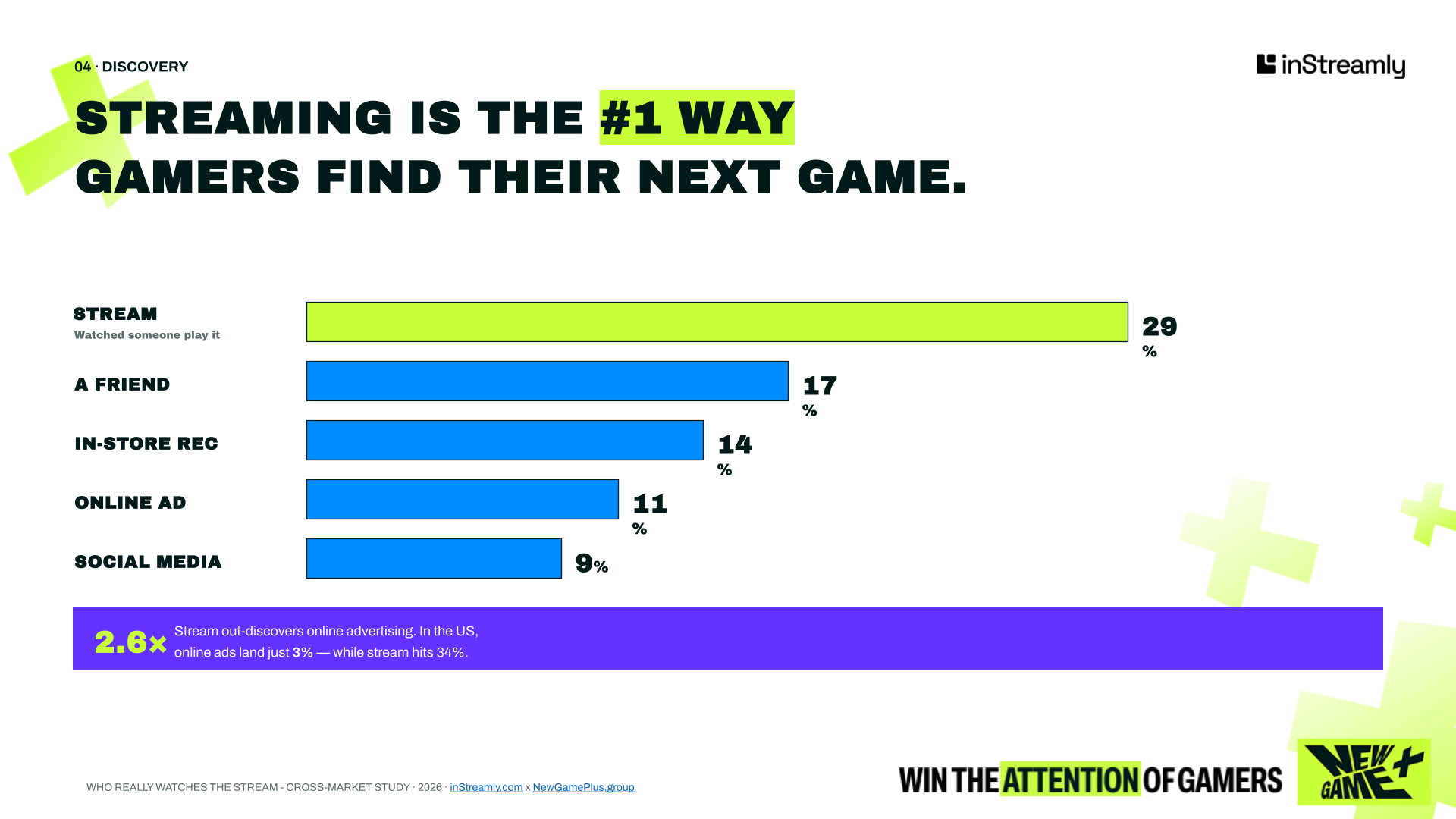
Across all markets, streaming has officially become the number one discovery channel for new games, completely eclipsing online ads, social media algorithms, and store recommendations. This shift is most dramatic in the US, where online ads account for a mere 3% of discovery among this group, compared to 34% for streams.
Furthermore, 77% of the entire audience has purchased a game after seeing it on a stream, with 24% doing so more than three times. Streaming doesn't just introduce new titles; it actively changes minds. Over half of the respondents (57%) admitted they initially had no intention of buying a specific game, but completely reversed their decision after watching a creator play it.
A unified cultural ecosystem, not isolated categories
Marketers often treat anime, esports, gaming, and content creation as separate silos. Our study reveals they are actually four sides of a single, deeply integrated cultural identity.
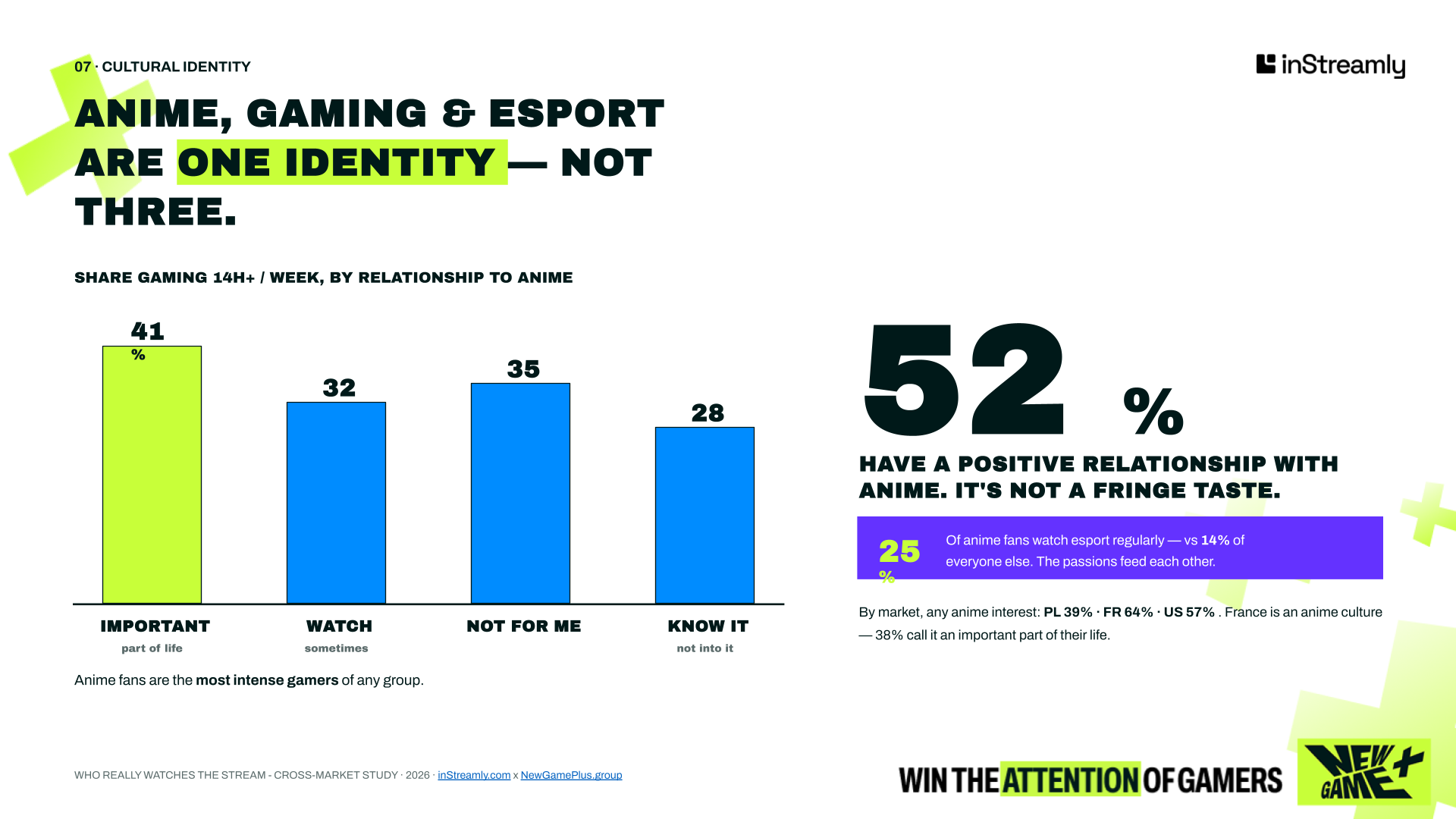
The overlaps are striking:
- The Creator Ecosystem: Stream viewers are not passive consumers. Between 65% and 70% of respondents either actively create content, have tried it, or aspire to do so. They sit on both sides of the camera.
- The Anime Crossover: Intense anime fans are the heaviest gamers in the entire study (41% play 14h+/week) and watch esports regularly at twice the rate of non-fans.
- Esports as Spectacle: Interestingly, regular esports viewing doesn't strongly correlate with heavy playing. In fact, 33% of non-gamers watch esports regularly. Esports has transcended the "player-only" space and now functions as a mainstream spectator sport.
Navigating Regional Nuances: US vs. France vs. Poland
While the core behaviors are global, executing a successful international campaign requires understanding sharp regional differences:
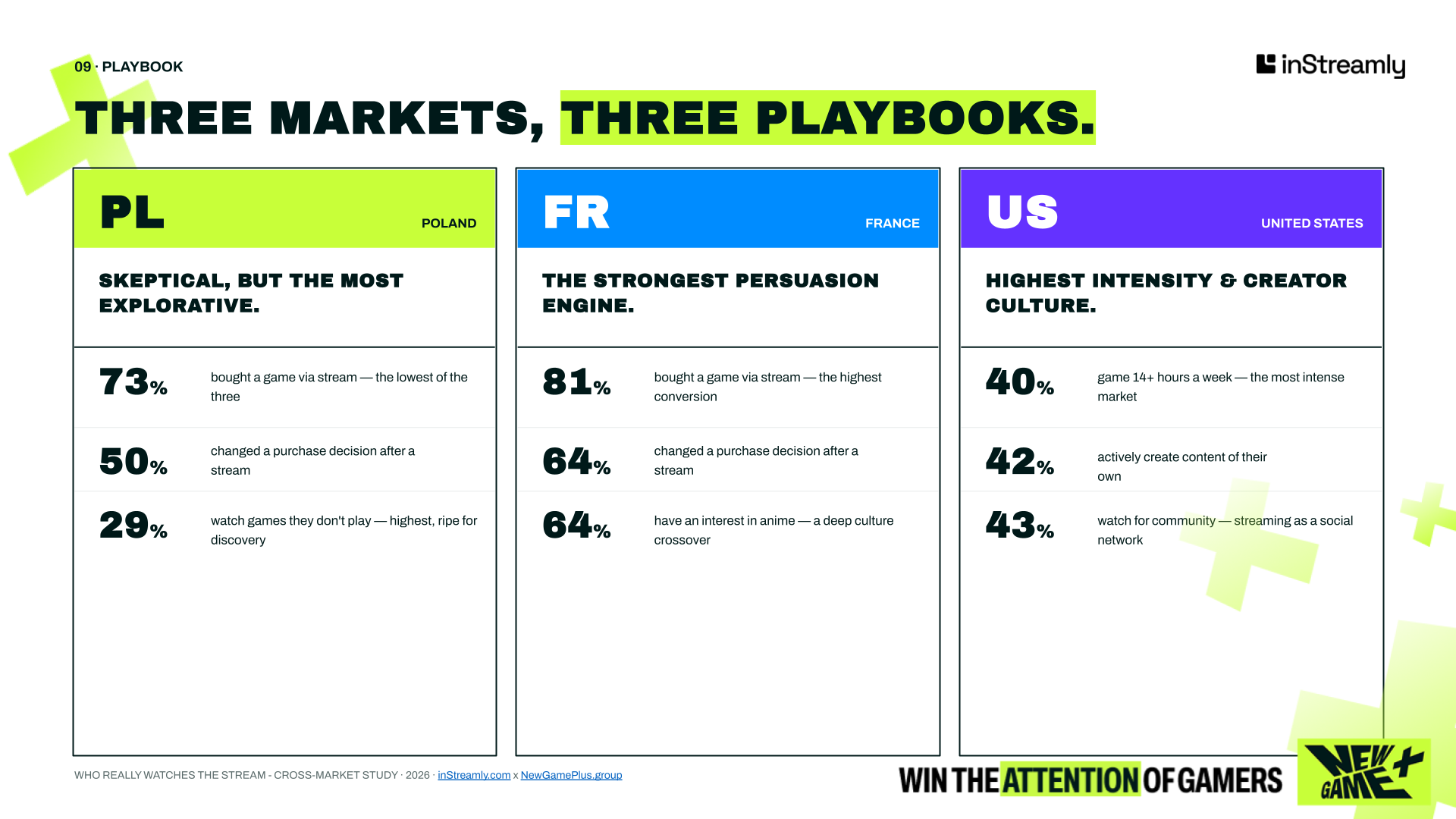
- The United States (The Community Hub): The US is the most intense and creator-driven market (42% active content creators). Crucially, 43% of Americans watch streams for the community aspect (compared to just ~20% in Europe). In the US, streaming is less of a sport and more of a social network.
- France (The Persuasion Powerhouse): France shows the strongest link between playing and watching (r = 0.47) and is deeply driven by anime culture (38% state it's a vital part of their life). It is the most responsive market to streaming persuasion: 81% have bought a game via a stream, and 64% changed their purchase intent because of a broadcast.
- Poland (The Curious Explorers): Polish viewers are naturally more skeptical and harder to convert immediately. They have the lowest conversion rates and are less likely to change their minds under a stream's influence. However, 29% of Poles watch streams of games they do not play (the highest in the study). This indicates a massive openness to discovery. They need a longer marketing funnel, but they are highly willing to explore new horizons.
Conclusion: Time to Re-align Your Strategy
The data collected by New Game + and inStreamly clearly shows that the streaming audience is mature, highly focused, inherently creative, and ready to buy. They don't just consume content; they live within a rich, interconnected ecosystem driven by a powerful parasocial bond with their favorite creators.
Brands that continue to treat gaming as a niche youth hobby or a simple awareness banner will be left behind. It is time to treat live streaming with the strategic weight it deserves: as a premium, high-attention conversion engine.
Want to dive deeper into the market-specific data, including insights into brands, creators, and sports preferences?