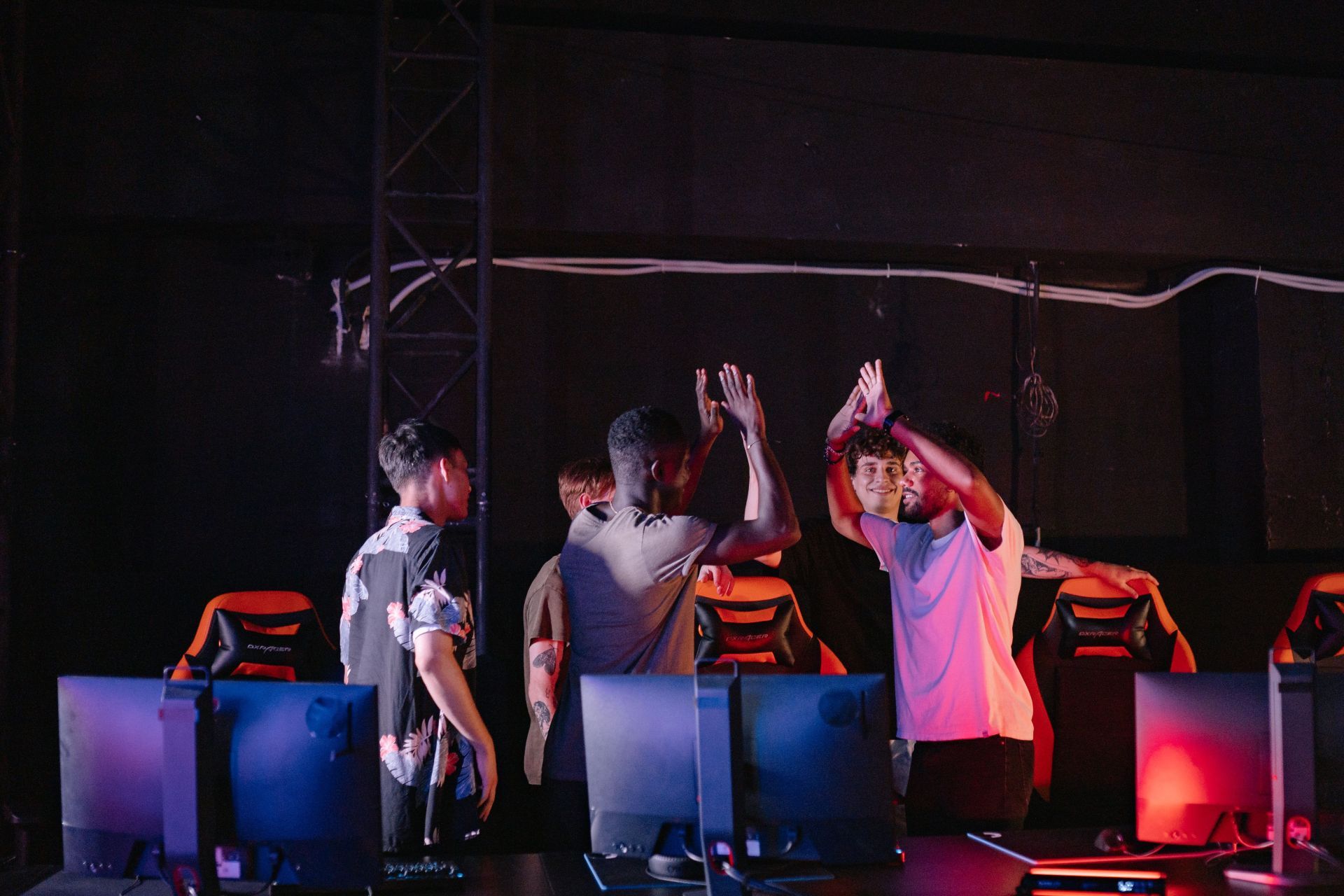



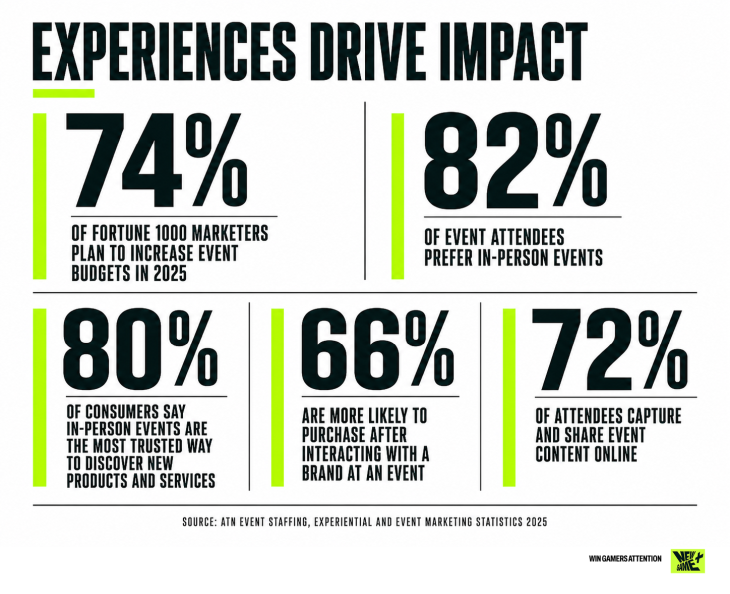
Experiential marketing is built on a compelling premise: physical presence creates the deepest brand connection. When a person walks through a branded environment, tries a product, speaks with a brand representative, and shares the moment with their phone, something happens that a 30-second pre-roll cannot replicate. The research supports this. Around 80% of attendees are more likely to trust a brand after engaging with it in person, according to ATN Event Staffing's 2025 experiential marketing data.
The problem is structural. A venue holds a fixed number of people. An activation at a festival in one city does not reach the person in another country who is the same age, has the same interests, and would respond to the same experience - if they could get there.
Gaming activations remove that constraint. A branded Fortnite map has no capacity limit and no geographic boundary. The attention depth that makes experiential valuable is present in both formats. The reach ceiling is not.
The geography problem in physical events
Experiential marketing reached $128 billion in global spending in 2024, surpassing pre-pandemic levels for the first time, according to MarketingProfs analysis. The category is growing because it works - 66% of consumers are more likely to purchase after interacting with a brand at an in-person event, according to EventTrack 2025 data.
But 92% of consumers say they prefer in-person events within an hour's travel distance, according to the same source. Which means the audience for any given physical activation is primarily local. Scaling it across markets requires a proportional increase in budget: another city means another build, another logistics operation, another on-site team.
For brands whose target audience is concentrated geographically, this is a manageable constraint. For brands targeting a demographic that is distributed globally - Gen Z gaming audiences, for example, who are present in every market but rarely concentrated in one - the physical event model is structurally inefficient.
What gaming activation removes from the equation
The PKO Bank Polski Fortnite map - PKO Rotunda - generated 590,000 map views and 9 million content views. It was accessible to anyone with a Fortnite account, anywhere Fortnite runs. The activation did not require travel, a ticket, or proximity to a specific venue. The geographic boundary was the game's player base, which is global.
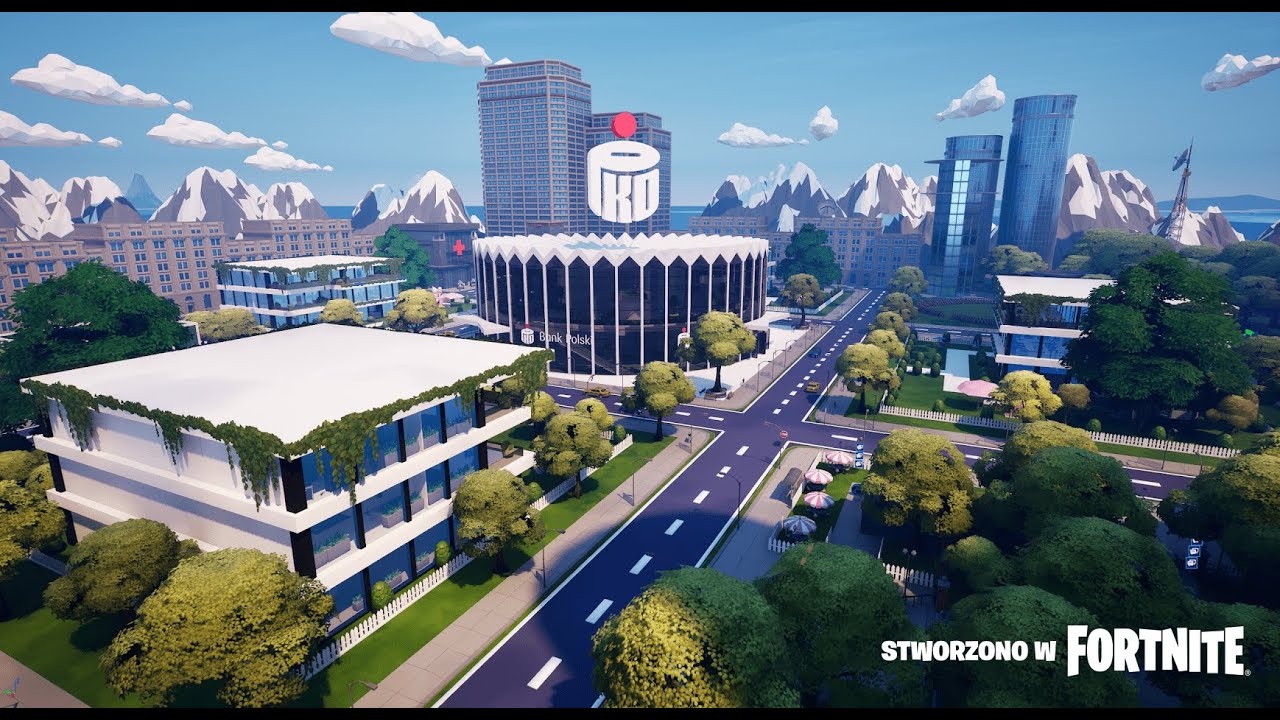
Average session time: 26 minutes. That is the attention depth experiential marketing promises - a participant who is actively choosing to be in the brand's environment, doing something within it, in a state of focus and engagement. It arrived without a venue, without logistics, and without a capacity ceiling.
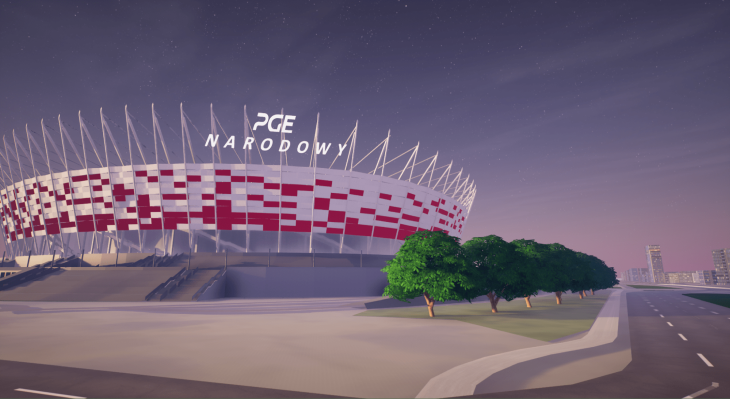
The Go2Warsaw campaign used Fortnite Creative to build a playable version of Warsaw's history across three eras - available globally, before a tourist even decides to book a flight. A city's perception among Gen Z audiences, in markets that have never sent a tourist to Warsaw, was addressed through a game. Geography became optional.
The attention comparison
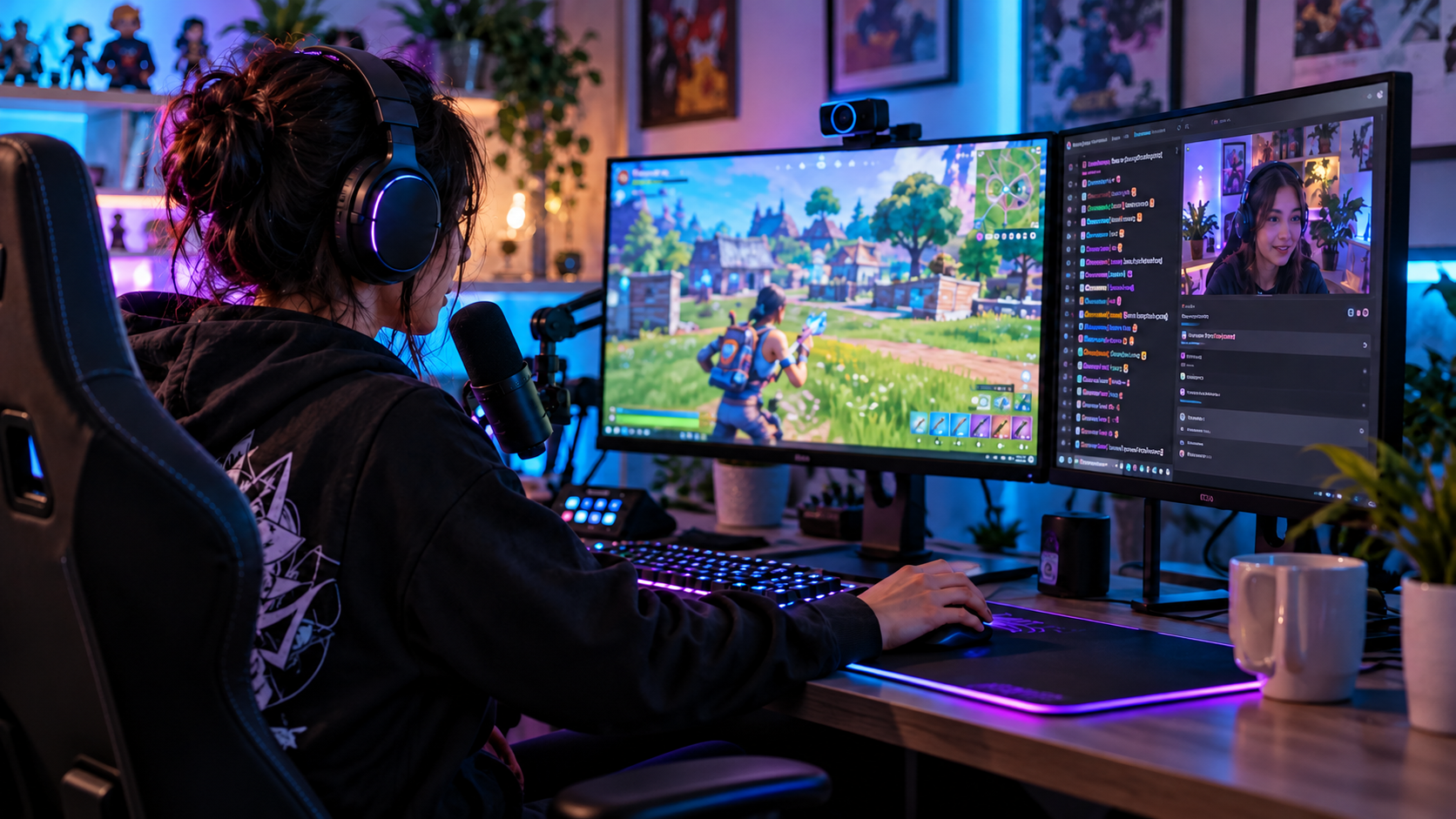
Experiential and gaming activations share something that distinguishes both from passive media: the audience is participating, not receiving. A person navigating a branded pop-up installation is making choices, moving through space, engaging with what the brand placed in front of them. A player inside a branded Fortnite map is doing the same thing.
This lean-forward quality is what makes experiential effective despite higher cost-per-contact than broadcast media. It is also what characterizes the gaming session. The average gaming session runs from 30 minutes to several hours. During that time, 73% of session time is spent in high concentration - the player is not passively consuming content, according to McKinsey and Dentsu research referenced in New Game +'s gaming marketing analysis. Compare this to the average TikTok view time of 3.3 seconds. The attention quality is structurally different.
The distinction between experiential and gaming activation is not quality of attention. Both formats can earn deep engagement. The distinction is reach architecture - one grows linearly with investment, the other does not.
Where gaming outperforms physical
Scale without proportional cost. Adding 100,000 players to a Fortnite map costs nothing additional. Adding 100,000 visitors to a physical activation requires a larger venue, more staff, more logistics. The PKO Bank activation accumulated 7+ months of total gameplay time across its player base - a number no physical event format could approach within a comparable budget.
Measurement precision. Gaming activations produce session-level data: time spent per visit, actions taken, return visits, content generated by players, community sentiment in real time. Physical event measurement typically relies on foot traffic estimates, post-event surveys, and social media monitoring. The data quality is not comparable.
Repeat engagement. A physical activation runs for a defined period, then closes. A branded game experience remains accessible. Players who visited the PKO Bank Fortnite map in month one could return in month three. The Mountain Dew creator school ran on Discord for an extended period, with 3,100+ participants spending an average of 47 minutes per day on the brand's platform - a cumulative engagement volume no single physical event format generates.
Organic content generation. Players share gameplay, screenshots, clips, and commentary. The Go2Warsaw campaign generated content well beyond the map itself, reaching audiences who never entered the experience but encountered it through the content of those who did.
Where physical events still win
The honest comparison requires acknowledging what gaming cannot replace.
Physical product trial is the primary category. A consumer trying a new food product, test-driving a car, or trying on a garment is in a sensory environment gaming cannot replicate. Where the conversion mechanism depends on physical contact with the product, the in-person event remains necessary at the conversion stage.
82% of event attendees prefer in-person events over virtual formats, according to Freeman's 2025 data cited by ATN Event Staffing. For B2B audiences, older demographics, and high-consideration categories where relationship-building is the objective, physical presence carries weight that digital formats do not.
The question is not which format is better. It is which format serves this objective, for this audience, at this stage of the relationship.
The hybrid logic
The most effective approaches use gaming activation for awareness and community-building - reaching audiences at scale, earning attention over time, building the kind of repeated positive contact that creates familiarity - and physical or product-level touchpoints for conversion.
Mountain Dew ran its creator school primarily through Discord, not through physical events. +33% increase in sales value among the 16–24 age group followed. The digital-first format reached an audience a physical event could not have assembled, built a community around the brand's values, and moved a business metric. Physical sampling or in-store activation could close the loop at the point of purchase - but the relationship was built in a gaming-adjacent digital environment first.
The experiential instinct - that immersive participation creates durable brand relationships - is correct. The assumption that it requires a physical venue is worth questioning.
The format decision framework
Use a gaming activation when: the objective is reach, awareness, or cultural integration with a gaming-adjacent audience; geography limits the physical event's effectiveness; the target audience is under 30; or the budget cannot scale across multiple physical markets.
Use a physical event when: the product requires sensory trial; the audience skews older or is non-gaming; the relationship is B2B or high-consideration; or the brand is operating in a geography where gaming penetration is low relative to the target demographic.
Use both when: the brand wants to build presence and familiarity at scale, then deepen that relationship through physical contact at the conversion stage. Gaming earns the audience. The physical touchpoint closes it.
A note on measurement
One reason gaming activations are sometimes undervalued in brand planning is that the metrics they produce do not map neatly onto existing reporting frameworks. Session time, return visit rates, community sentiment scores, and organic content volume require a measurement infrastructure that most marketing teams built for broadcast and social formats. The result is that gaming activations often get evaluated by reach and impressions - the metrics the team already knows how to report - rather than by the signals that actually indicate whether the brand earned genuine engagement.
Physical experiential events have the same problem in reverse: they tend to overreport the depth of connection and underreport the geographic concentration of their audience. Both format types deserve better measurement than most brands currently apply to them. The comparison between them is most useful when both are measured on the same terms: how much genuine attention did the brand earn, from whom, and for how long?
Key takeaways for marketers
- The attention quality that makes experiential effective - lean-forward, participatory, chosen engagement - is also present in gaming activations
- The difference is reach architecture: physical events scale linearly with investment, gaming activations do not
- The PKO Bank Fortnite map generated 590,000 map views and 26 minutes of average session time with no geographic limit
- Physical events remain essential where product trial is the conversion mechanism; gaming is not a replacement for sensory contact with a product
- The most effective approaches use gaming for awareness and community-building, and physical touchpoints for conversion