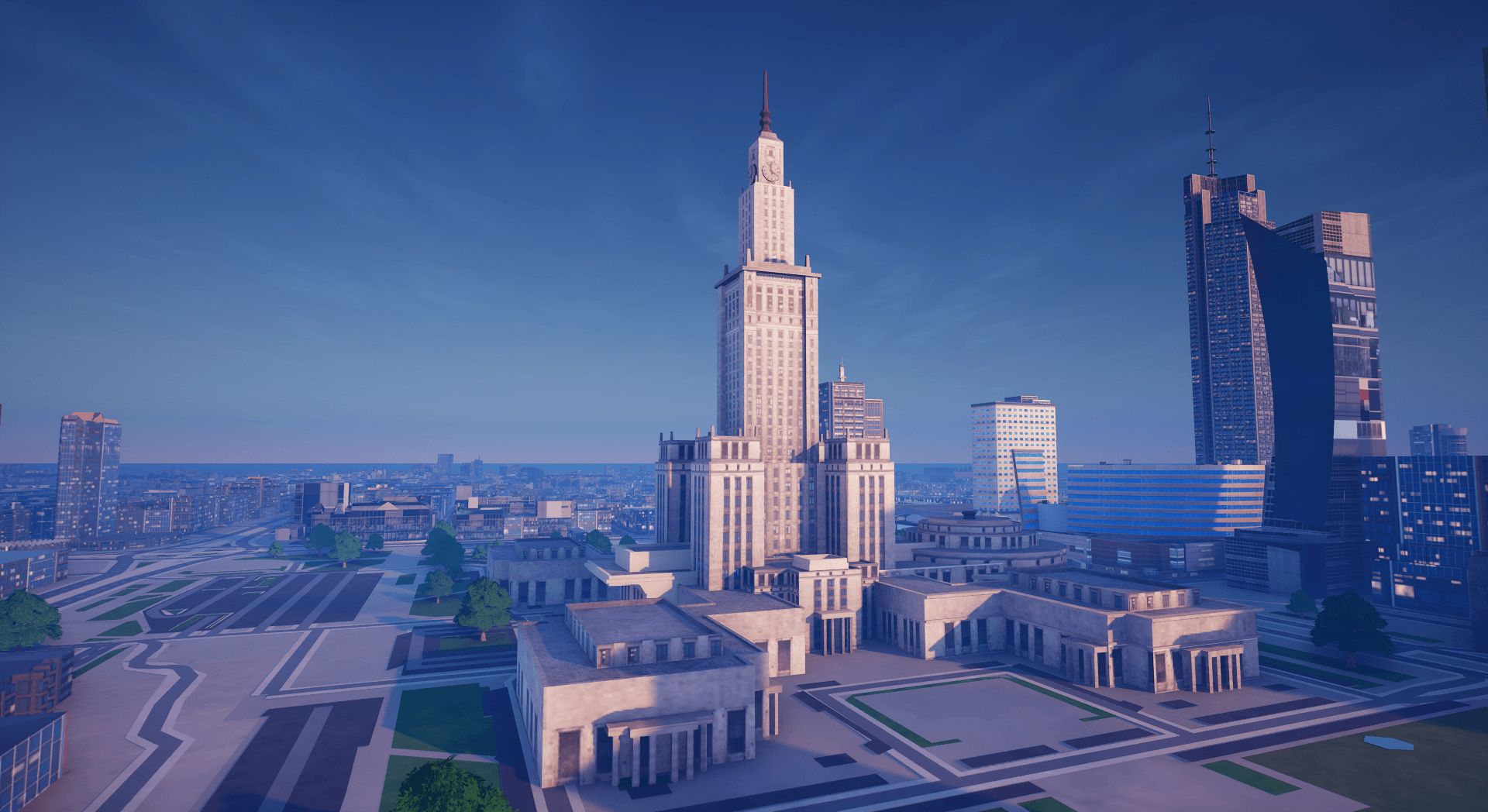



PKO Bank Polski built a custom Fortnite map, kept developing it across multiple seasons, and kept adding new gameplay and mechanics on top of it. A single Twitch integration lasts a few weeks and gets forgotten by the next patch cycle. Both moves count as "gaming marketing." Only one of them compounds.
That distinction between a one-off action and an ongoing presence is the actual decision a brand makes before it ever picks a platform, a streamer, or a format. Most gaming briefs skip straight to the format question. Fortnite or Roblox? Twitch or Discord? UGC contest or branded item? None of that matters yet, because the choices that make a presence durable happen one step earlier: why the brand is there, who it wants to be remembered by, and which touchpoints it is willing to keep funding after the launch buzz fades.
What comes before you pick a format?
A short-term, sales-focused push can work without a strong existing brand behind it. A long-term presence cannot. If gamers do not already have some association with the brand, there is nothing for repeated touchpoints to build on, and every activation starts renegotiating trust from zero.
So the first decision is not a platform. It is a goal: is this brand entering gaming to move product now, or to build recognition and affinity that pays off over multiple campaigns? That goal determines everything downstream, including which of the audience approaches below actually fits.
Who exactly is this presence for?
Gaming communities do not blend into one audience. A League of Legends player and a Counter-Strike player follow different creators, use different slang, and rarely cross into each other's spaces. That clustering is the reason "reach gamers" is not a targeting strategy, and it is also why a brand has three genuinely different ways to define who it's talking to.
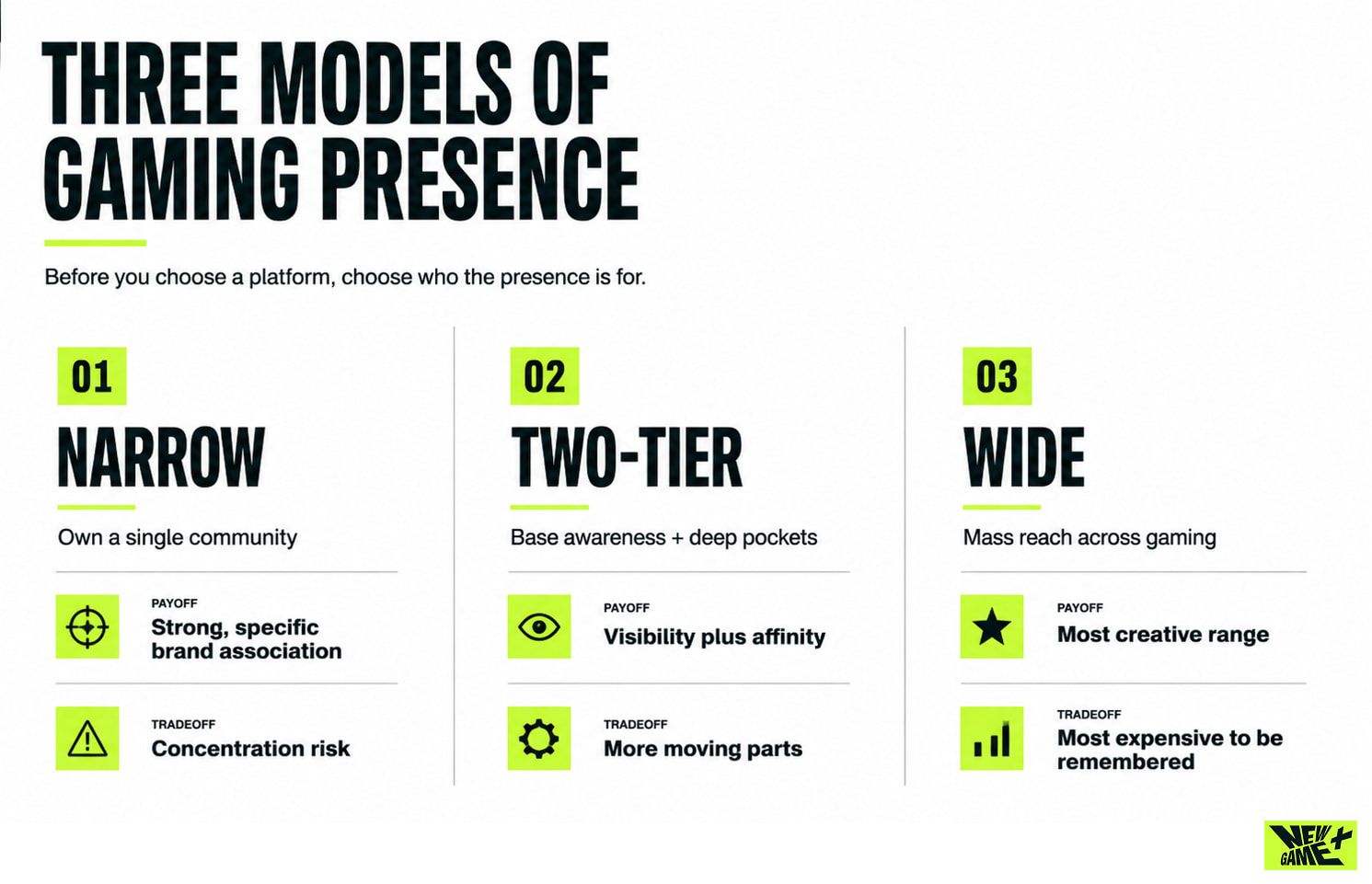
1. Go narrow: own a single community
- What it means: commit to one player community, for example a custom space in Roblox or Fortnite, and stay there
- Payoff: a strong, specific brand association a broad campaign cannot buy, in a target group that can still be large with the right community
- Tradeoff: concentration risk, since the brand's gaming identity now depends on that one community staying relevant
2. Go two-tier: base awareness plus deep pockets
- What it means: run two layers at once. A broad in-stream campaign across thousands of streams builds baseline visibility, while deeper activations run inside two or three selected communities (for example one built for a Counter-Strike audience and another for League of Legends)
- Payoff: the wide layer keeps the brand visible everywhere, while the narrow layers build the affinity that visibility alone cannot buy
- Tradeoff: more moving parts to plan and fund at the same time
3. Go wide: mass reach across a heterogeneous audience
- What it means: optimize for reaching as broad and varied a gaming audience as possible, without anchoring to one title or genre
- Payoff: the most room for creative range, since the brand isn't constrained to a single game's culture
- Tradeoff: the most expensive path to being remembered, since a wide, non-uniform audience takes a bigger budget to register at all
Which of the three fits depends on the brand's positioning goals and on which gamer segments actually match its Gamer DNA profile, not on which format looks most exciting in a pitch deck.
Short-term tactics are not a strategy
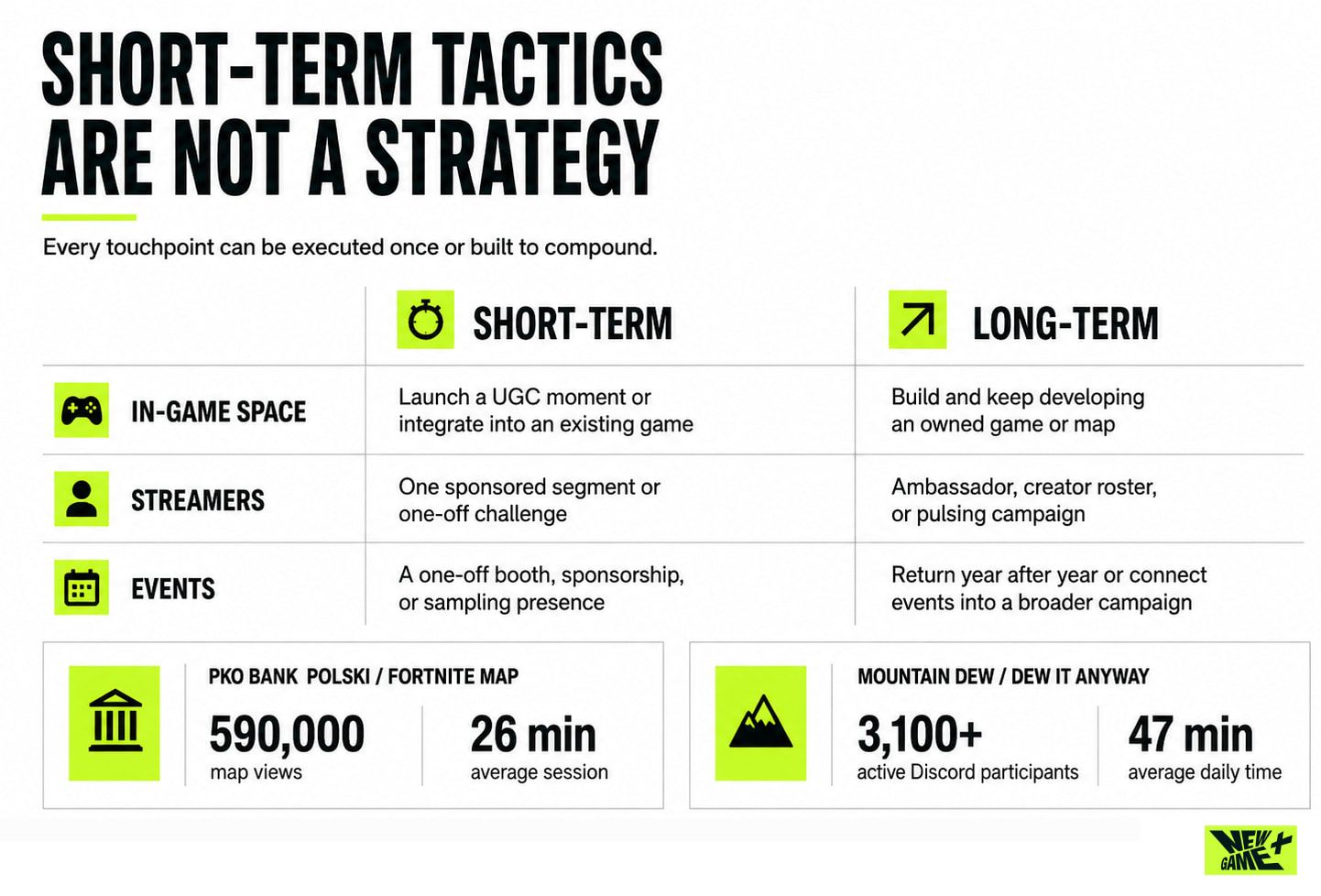
Once the audience approach is set, the third stage is planning: what to build, at what scale, and in what creative form. This is where most brands default to whatever single tactic is available this quarter. A more useful way to plan is to look at each touchpoint category and ask what it looks like done once versus done as an ongoing commitment, because the two versions have different costs and different payoffs. The three touchpoint categories below all follow the same split.
Building an owned space in-game
Short-term:
- Launch a UGC system for a single moment
- Integrate into an existing game such as Roblox, currently one of the most common entry points because it does not require building a game from the ground up
- Fast, lower-investment way to test whether an audience responds
Long-term:
- Build and keep developing an owned space: a game or map the brand keeps expanding
- Layer content, campaigns, and reasons to return on top of it over time
- Proof point: PKO Bank Polski's Fortnite map. The bank didn't launch once and move on. It kept the map live, added new gameplay and seasons on top of the original concept, and turned it into a recurring reason for players to come back, generating 590,000 map views and an average session of 26 minutes of voluntary, uninterrupted engagement with a bank
The tradeoff is real: an owned space needs sustained investment and time before it pays off. What it buys in return is owned equity. That 26 minutes was not exposure borrowed from someone else's platform. It was time spent directly with the brand.
Branded items or mods dropped into existing games sit outside this framework entirely if there is no surrounding communication. They are present, but presence without communication is not a long-term strategy. It is just an asset sitting in a game.
Turning one streamer mention into an ongoing relationship
Short-term:
- A single sponsored segment or a one-off challenge builds a moment of visibility and nothing more
- A broad in-stream campaign across many streamers can also be run as a short burst, building awareness across categories without any commitment beyond that window
Long-term: a deliberate decision to not stop after one action. It takes one of three forms.
- Ambassadorship. Instead of a single paid mention, a creator becomes a recurring face of the brand, with a segment, a recurring bit, or an event tied to them that shows up regularly.
- Standing creator roster. Activations that are not one-off but appear on an ongoing basis, across different communities, as a conscious operating decision rather than a campaign calendar entry.
- Pulsing campaign. Live for a month, paused, live again the following month, with the creative and concept changing each cycle while the brand's presence in the space never fully disappears.
Mountain Dew's Dew It Anyway shows what the ambassador and community version looks like at full scale. Instead of a single influencer placement, the brand built Poland's first creator accelerator on Discord, with more than 3,100 active participants spending an average of 47 minutes a day inside a brand-run platform, well past what a single sponsored post could generate. The commitment was the point: participants got real training, not a slogan, and that is what earned genuine loyalty rather than a single burst of impressions. For more on how these creator relationships get structured, see how brands work with streamers and creators.
Are events a presence or just a stop on the calendar?
Short-term: a one-off event presence, whether that's a sponsorship, a sampling booth, or a branded stand, generates a moment and then ends.
Long-term works differently, in two ways.
- Repeated presence at the same events, year after year. This becomes a recognizable pattern in its own right, as long as the brand has a reason for being there each time and refreshes that reason instead of repeating the same booth.
- Events as part of a larger ongoing campaign. A brand that runs contests throughout the year to win tickets and attendance, supported by creators and stream campaigns, and then shows up at the event itself has turned the event into a touchpoint inside a bigger story instead of an isolated activation.
Is your gaming presence built to last?
Every one of these touchpoints can be executed as a single action. The brands that get remembered are the ones present across several of them at once, over time, which is what separates being seen as a fixture in a gaming community from being seen as a tourist passing through. Before greenlighting an activation, run it against this checklist:
- Does the brand have any presence when there is no active campaign running?
- Do players have a specific reason to come back next month, not just this week?
- Does a community around the brand exist independently of the brand's own activity?
- Are the creator relationships involved ongoing, or are they one-time media placements?
- Is there a plan for what gets measured this time and how it changes what gets built next?
That last point matters more than it looks. Long-term presence is the only structure that lets a brand learn: which creators actually drove engaged traffic, what content the community shared without being asked, what questions or objections came up in the comments. Each activation built on that feedback gets sharper than the last, and the relationships built with creators along the way earn the brand more creative freedom and more authenticity than any single campaign brief could specify upfront.
Key takeaways
- Decide why the brand is entering gaming and what it wants to be remembered for before choosing a platform. Short-term sales pushes and long-term brand building need different starting points.
- Choose deliberately between a narrow community, a two-tier reach-plus-depth model, or a broad mass-reach approach. The right choice depends on positioning goals and gamer DNA fit, not on format novelty.
- For every touchpoint category, in-game, streamers, and events, define the short-term version and the long-term version separately, since they carry different costs and different paybacks.
- Long-term presence is what turns a gaming budget into owned equity and a functioning feedback loop instead of a series of disconnected campaigns that each start from zero.