



The gaming marketing landscape has more specialists in it than it did three years ago. Dedicated agencies, esports consultancies, creator marketplaces, influencer platforms, and full-service hubs all compete for the same brief. Most of their positioning sounds similar: gaming-native, community-first, authentic, culturally fluent. The vocabulary is identical. The underlying models are not.
The difference between a gaming agency and a gaming marketing hub is not a matter of scale or service breadth. It is a question of whether the partner treats each campaign as a standalone project or as part of a system that compounds over time. That distinction determines whether a brand builds something durable in gaming, or spends the same budget repeatedly on the same cold start.
What a gaming marketing agency typically offers
A specialist gaming agency brings platform fluency, creator relationships, and category-specific expertise. It knows how Twitch operates differently from YouTube Gaming, which streamers in a given genre have genuine community trust rather than purchased reach, and which creative formats work for which game audiences.
The global gaming industry reached $522 billion in 2025 with over 3 billion active players, according to market data compiled by EAK Digital. The size of the channel has produced a mature ecosystem of specialist partners. A good gaming agency can execute an influencer campaign, manage an esports sponsorship, run a Fortnite Creative build, and report on brand lift - all competently.
What most agency relationships do not offer is continuity between campaigns. When a brief ends, the relationship pauses. The learnings from that campaign - which formats moved the audience, which streamers converted, which creative approaches the community accepted or rejected - stay in a report. The next brief often starts fresh, with a new scope of work, a new set of streamers to onboard, and a new brand safety setup to configure.
For brands running one-off activations, this is fine. For brands that want gaming to function as a real channel in their annual plan, this model accumulates cost without accumulating knowledge.
What a gaming marketing hub offers instead
A hub functions as a system partner rather than a campaign vendor. The distinction is operational, not semantic.
Strategy, creative, technology, media, and measurement sit inside one framework. Each campaign produces data that informs the next one - not as a post-campaign report that goes into a drawer, but as a learning loop that changes how the following brief is constructed. The hub knows what the brand's gaming audience responded to in Q2 because it ran Q2. That knowledge reduces risk and improves returns on Q3.
New Game + operates through the Gaming 360° Engine - a decision framework built across 1,000+ campaigns in 15 countries. That history produces something a campaign-by-campaign agency relationship cannot: institutional knowledge about what works per category, per format, per audience profile. A pharmaceutical brand entering gaming for the first time benefits from what worked for the pharma campaigns that came before it. A bank considering its second Fortnite activation benefits from what the first one taught about session behavior and community reception.
This is not a service list distinction. It is a compounding advantage that grows with each campaign.
The cold-start problem
Every gaming campaign begins with a setup phase: streamers are researched and contacted, brand safety parameters are configured, creative is briefed, community norms for the specific game or platform are mapped. This work costs time and budget before a single impression is delivered.
In an agency-by-project relationship, that setup happens again with each new brief. The agency may retain some institutional knowledge about the brand, but the operational machinery - the creator roster, the safety monitoring configuration, the creative learning from prior executions - resets or requires renegotiation.
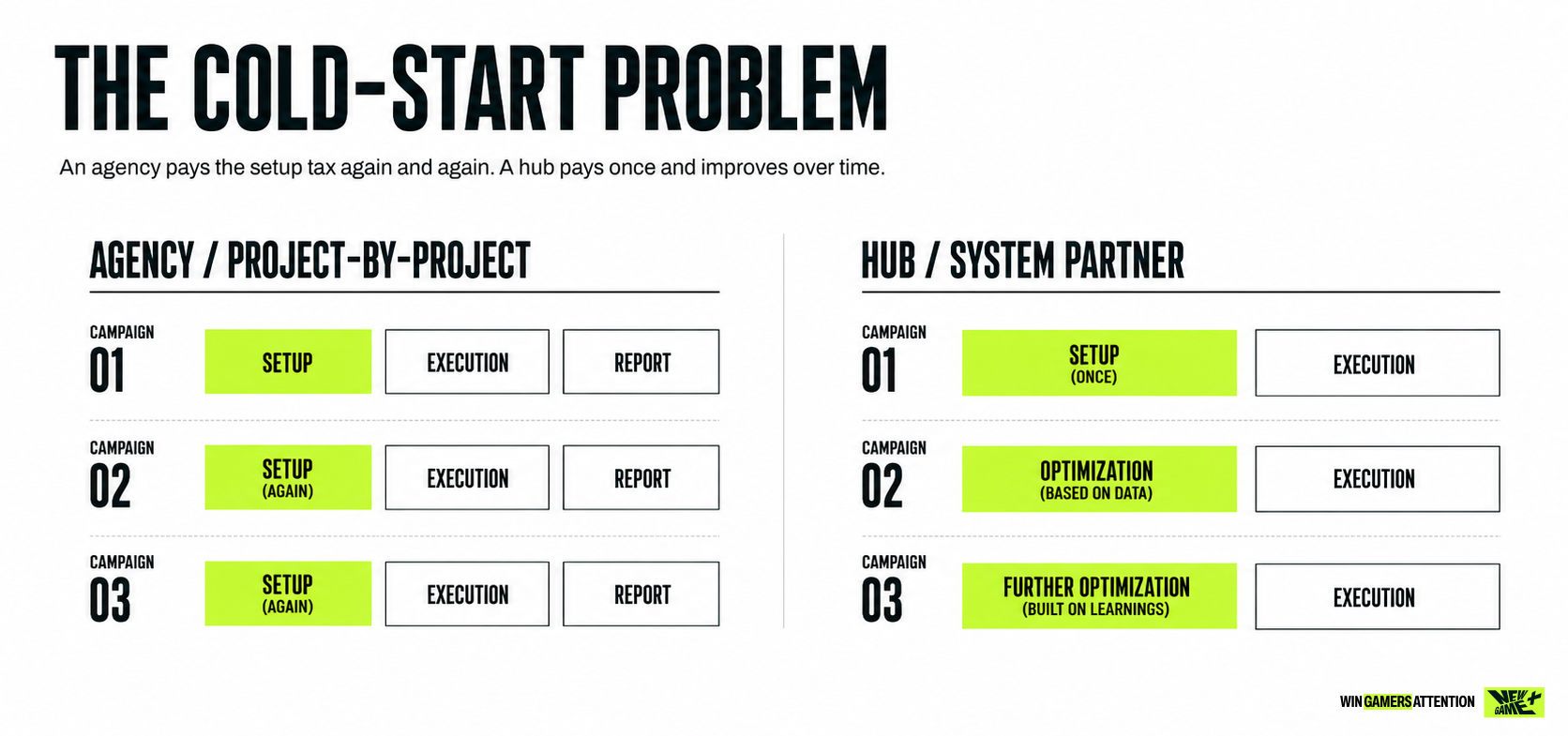
Over multiple campaigns, this adds up. A brand that runs three gaming campaigns per year through separate agency engagements pays the cold-start cost three times. A brand working within a system partner relationship pays it once and builds on it.
How to evaluate a potential gaming marketing partner

The evaluation question most brands ask is: "Have you done this before?" That question is necessary but not sufficient. The more useful questions are about continuity and compounding.
Cultural fluency: Can the partner explain - without a deck - the specific community differences between a Fortnite Creative player and a competitive League of Legends player? Do they know which streamers in the brand's target category have genuine audience trust versus reach purchased through algorithmic promotion?
Technology access: Does the partner have proprietary tools for contextual targeting, brand safety monitoring, or creator discovery? Or do they rely on the same third-party influencer platforms available to any brand with a budget?
Cross-campaign continuity: Can they show specifically how campaign one changed the approach to campaign two, and campaign two changed campaign three? If every campaign is presented as a standalone success story with its own metrics and no reference to what came before, there is no system. There is a series of individual projects.
Measurement depth: Do they measure brand lift, sentiment, and attention quality - or only impressions, reach, and views? The former requires infrastructure. The latter requires a spreadsheet.
Category experience: Have they worked in the brand's specific sector before? A gaming campaign for a bank requires different community knowledge than a campaign for a snack brand, even if both run on the same platforms.
The questions that reveal the difference
In a procurement conversation, these questions separate a campaign executor from a system partner:
"What did you learn from your last campaign in our category that would change how you'd approach this one?" A system partner answers with specific learnings. A campaign executor answers with a case study.
"How does your technology differentiate the results you deliver from what we could buy through a standard influencer marketplace?" A system partner describes proprietary mechanisms - contextual triggers, real-time safety monitoring, personalized creative generation. A campaign executor describes a managed service built on tools anyone can access.
"If we ran five campaigns with you over two years, what would compound?" A system partner can answer this specifically: audience profile data, creative performance patterns, streamer relationship depth, reduced setup costs, improved targeting precision. A campaign executor may not have thought about the question at all.
When the agency model is the right choice
An agency-only approach makes sense when the brand is running a genuine one-off: a product launch with a defined window, a seasonal activation that will not recur, a single esports sponsorship with no follow-on planned. It also makes sense when the brand has strong in-house gaming expertise and needs execution capacity rather than strategic input.
In these cases, the cold-start cost is a one-time expense, not a structural problem. A specialist gaming agency with demonstrable platform experience and genuine creator relationships delivers what the brief requires.
When to insist on a system partner
The case for a system partner is clear when gaming appears regularly in the annual marketing plan, when the target audience is genuinely a gaming audience rather than "young people who might play games," and when the brand has already run gaming campaigns and found each one starting from scratch.
The Łaciate Protein+ Battle campaign by Mlekpol illustrates what happens when a system partner manages a brand's first gaming activation correctly: 1,012,768 total campaign views, 126% KPI execution, +17pp ad recall, +16pp brand consideration - and a community reaction that created the conditions for a follow-on campaign rather than a one-off experiment.
That outcome is not available from a standing start with a new agency relationship. It comes from a partner that understood, from brief to execution, how to build something that earns community acceptance rather than just purchasing reach.
Key takeaways for marketers
- The distinction between a gaming agency and a gaming marketing hub is not about size - it is about whether the partner treats campaigns as standalone projects or as a compounding system
- The cold-start problem is real: each new agency engagement resets operational learning, and brands pay for that reset repeatedly
- Evaluating a gaming partner requires asking about cross-campaign continuity, not just prior campaign performance
- Agency-only relationships work for genuine one-offs; system partners work when gaming is a recurring channel
- The question that matters most: if we run five campaigns with you over two years, what compounds?